Updated 12 November 2026, with every source rechecked
What does basement tanking cost?
What basement tanking and cellar waterproofing cost, for Oxford owners with a damp cellar or plans to convert one. We give published national yardsticks with their sources, explain how BS 8102 Types A, B and C change the bill, and why Oxford's shallow groundwater makes a survey the first step.
Book a damp survey
Postcode, phone number and a word about the problem. We call back, ask a few questions, and book a visit if it needs one.
How much does basement tanking cost per square metre?
Figures vary widely with the system and the cellar, and a conversion costs far more than waterproofing alone. These are other publishers' national averages, with the date each page carries, not Oxford quotes or prices from Oxford Damp Specialists.
| Work | What the publisher gives | Source | Dated |
|---|---|---|---|
| Tanking a cellar or basement | Average £125 a m² (range £100 to £200) | Checkatrade, damp proofing cost guide | Nov 2024 table |
| Cellar tanking | Small cellars from £40 a m²; large ones £80 a m² or more | MyBuilder, tanking price guide | No date given |
| Tanking slurry, applied by a contractor | £30 up to £60 a m² | Homebuilding and Renovating | 9 April 2024 |
| Cementitious tanking | £60 to £120 for each m² | MyBuilder, conversion price guide | Figures for 2026 |
| Cavity drain system | £80 to £150 for each m² | MyBuilder, conversion price guide | Figures for 2026 |
| Waterproofing from outside | £100 to £200 for each m² | MyBuilder, conversion price guide | Figures for 2026 |
| Damp-proof membrane | £50 to £80 for each m² | MyBuilder, conversion price guide | Figures for 2026 |
| Installing a sump pump | Between £500 and £1,500 | MyBuilder, conversion price guide | 2026 figures |
| Labour by the day | Specialists £200 to £400; general contractors £110 to £220 | MyBuilder, tanking price guide | Undated |
| Converting a typical 20 m² cellar | £30,000 up to £50,000 | MyBuilder, conversion price guide | 2026 figures |
| Victorian cellar conversion, floor lowered | From £25,000 to beyond £100,000 | MyBuilder, conversion price guide | 2026 figures |
Our price for your cellar is confirmed when you book.
How do BS 8102 Types A, B and C change the cost of waterproofing a cellar?
The type decides what your money buys: a membrane or coating on the walls, walls and floor built to keep water out, or a drained cavity with a pump that needs looking after. BS 8102:2022 is the code of practice for below-ground waterproofing, and the British Standards Institution sets out its three types:
- Type A: barrier materials applied to the structure, which is what most people mean by tanking;
- Type B: construction that is itself watertight, so the walls and floor resist water;
- Type C: a drained cavity, which LABC explains lets water into the structure, then collects it and carries it away from the rooms in use.
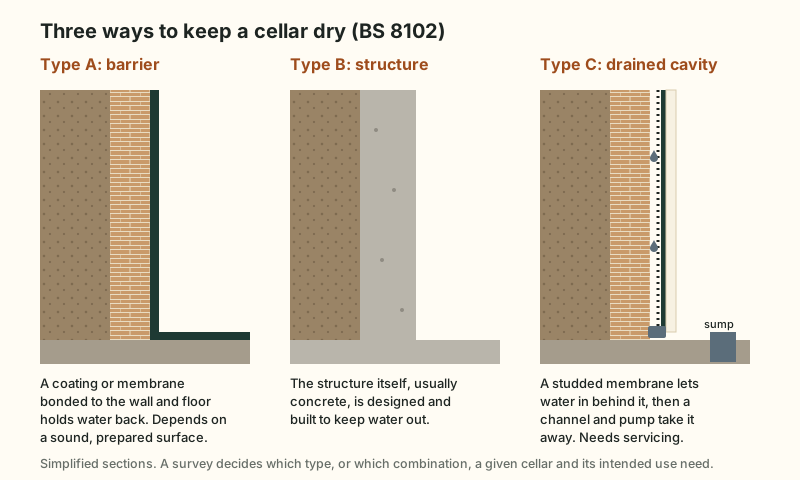
On MyBuilder's 2026 conversion figures, cementitious tanking (£60 to £120 per m²) and a cavity drain system (£80 to £150 per m²) overlap, so the installation price rarely settles it alone. Type C brings a pump and servicing. Type A has no moving parts, but SPAB calls tanking expensive and dependent on flawless workmanship, and prefers a pumped sump for cellars in old buildings.
The grade matters as much as the type. As quoted by The Concrete Centre, BS 8102:2022 runs from Grade 1a, which tolerates some seepage and damp patches, to Grade 3, which accepts no water getting in and no damp areas at all. A consultancy summary from CLW places habitable rooms in Grade 3. A storeroom and a bedroom need different designs.
What does a cellar sump pump cost to install and keep running?
MyBuilder gives £500 to £1,500 to install a sump pump (2026 figures), and the ongoing cost is servicing. The Property Care Association calls maintenance essential to a Type C system lasting: service it at least yearly, make the first visit within three months of commissioning, and have pumps properly checked, tested and commissioned.
Annual servicing has no reliable national yardstick, so ask every firm to price it in writing next to the installation. LABC notes a Type C system must stay reachable for servicing and maintenance, so check the design leaves the sump and channels accessible once the room is finished. An RICS isurv article on insurance-backed guarantees lists lack of maintenance among common exclusions, so a skipped service can matter later.
Do I need Building Regulations approval to turn an Oxford cellar into a room?
Yes, for a habitable conversion. The Planning Portal confirms that Building Regulations cover both new basements and conversions of existing ones, including how people escape in a fire, ventilation and damp proofing. LABC adds that Approved Document C points to BS 8102 for designing basements whose walls and floors face water pressure, and that responsibility for compliance rests with whoever carries out the work.
Planning permission is a separate question. Turning an existing basement into a room seldom needs it, though it sometimes can, whereas excavating a new basement is likely to, according to the same Planning Portal page. Under section 55 of the Town and Country Planning Act 1990, works begun after 5 December 1968 that add space underground fall outside the usual exemption for interior work.
A listed house is likely to need consent for work inside or out, the Planning Portal adds. Oxford City Council confirms the inside of a listed building is listed too, and charges no fee for a consent application. Allow for these steps before comparing tanking prices.
Why does Oxford's high groundwater make a cellar survey worth paying for?
Because in much of Oxford the water pressing on a cellar wall comes up from the ground, not just from the rain. A British Geological Survey and Environment Agency study found the shallow gravel aquifer typically less than 1 m below ground in winter and about 2 m in summer, well connected to the rivers. It reports that a lot of the homes flooded in 2000 and 2003 suffered from groundwater only, and that some pre-war basements, often converted to living space, flooded from high groundwater.
In July 2007 more than 200 properties in Oxford flooded internally, and for New Hinksey a BGS and Environment Agency paper concludes that groundwater rising to the surface caused the flooding. The council's Jericho study notes the water table there is near the surface, leaving some houses with only a shallow lower ground floor, and around Beaumont Street and Walton Street the conservation area appraisal records that many terraces have basements.
A survey should establish whether water arrives as seasonal groundwater, a leaking drain, a faulty gutter or condensation, because each needs a different answer at a different price. On a basement tanking survey, Oxford Damp Specialists checks drains and ground levels and asks when in the year the water appears. The 2022 revision of BS 8102 added guidance on using experienced, competent contractors; one fair question for any firm is whether its designer holds the PCA's Certificated Surveyor in Structural Waterproofing (CSSW) qualification.
What should a fair basement waterproofing quote include?
A fair quote says where the water comes from, what protection type and performance grade the design targets, and what it will cost to keep working. Ask for:
- the diagnosis (groundwater, drainage, rain or condensation) and how it was established;
- the intended use and target grade, such as storage or a habitable room;
- the type or combination of types, the area in square metres, and what happens to existing plaster and floors;
- for Type C, the pump, any battery backup, commissioning, the first service within three months and the yearly servicing cost;
- Building Regulations, consent if listed, making good, and who returns if water appears.
Get at least three quotes, as Which? advises for damp work. For damp above ground, see our guide to damp proofing costs, and for how Oxford Damp Specialists works across the city, see damp proofing in Oxford.
Common questions
Which costs less, tanking or a cavity drain membrane?
Published figures per square metre overlap, and a drained system also needs pump servicing.
How often does a drained cellar system need a service?
A Type C system with a pump needs one at least yearly, with the first visit within three months of commissioning.
Will converting my Oxford cellar need planning permission?
Converting an existing cellar seldom does, while excavating a new one is likely to. Building Regulations apply to conversions, and a listed house is likely to need consent.
Could Oxford Damp Specialists quote for my cellar over the phone?
Not reliably, as the water source, grade and size all change the design. The price is confirmed when you book, after a basement tanking survey.
Sources for this page
- Damp proofing cost breakdown. Checkatrade, page updated 6 Apr 2025; prices Nov 2024
- Cost of tanking a cellar. MyBuilder, undated
- How much does damp proofing cost? Homebuilding & Renovating, 9 Apr 2024
- Cellar conversion cost. MyBuilder, 2026 figures
- BS 8102:2022, Protection of below ground structures against water ingress. BSI Knowledge, 31 Mar 2022; catalogue page
- Out of sight, out of mind? Protect below-ground structures from the power of water. BSI blog, undated
- Basement waterproofing and BS 8102: how to achieve compliance with the Building Regulations. LABC, 11 Dec 2015
- Technical Advice Note, Control of Dampness, Douglas Kent. SPAB, 2018; Edn 1 Rev 1, 2020
- Watertight concrete structures to BS 8102:2022. The Concrete Centre, 9 May 2022
- BS 8102 Table 2 performance grades. CLW (waterproofing consultancy), undated
- Key considerations for Type C waterproofing. Property Care Association, 31 May 2019
- Insurance-backed guarantees: pros and cons, Laurence Cobb. RICS isurv, 25 Jan 2018
- Basement conversion, planning permission and building regulations. Planning Portal, undated
- Town and Country Planning Act 1990, s.55. legislation.gov.uk, revised
- Listed buildings in Oxford. Oxford City Council, page dated 12 Dec 2023
- Listed building consent. Oxford City Council, page dated 12 Dec 2023
- Environment Agency et al.), Investigating the interdependencies between surface and groundwater in the Oxford area, c.2007. Macdonald et al. (BGS
- Dixon, Newell, Hallaways (BGS/EA), Groundwater flooding within an urbanised floodplain, undated in text (post-July 2007). Macdonald
- Jericho Conservation Area Designation Study. Oxford City Council, Oct 2010
- Central Conservation Area Appraisal – Character Zone 7, 19th-century Residential Quarter, undated. Oxford City Council
- CSSW examination. Property Care Association, undated
- How much does it cost to repair damp?, Adam Snook. Which?, 5 May 2026
Before you call
A few details let us narrow down the likely cause on the phone.
- Postcode and the rough age of the building
- Which rooms and walls, and how far up
- Whether wet weather or cold snaps change it
- Where any mould is growing
- Owner, tenant or buyer, and any deadline
Want someone to look at it? Our damp proofing in Oxford page sets out what we survey, what we repair and where we work.
The work this guide touches on
Basement and cellar tanking
Oxford sits on gravels where winter groundwater can lie under a metre down, so a dry cellar needs the right protection type.
Damp surveys
Before you exchange, accept a retention or agree to injection work, find out where the water in that Oxford wall is really coming from.
Other guides
How much does damp proofing cost?
Damp proofing prices swing from a modest survey fee to thousands for a new damp course, and the right diagnosis decides which one you pay.
What does woodworm treatment cost?
Those tiny round holes in your floorboards may be decades old, so prove the beetles are alive before paying anyone to spray.
Why is there condensation in my bedroom?
Wet glass at dawn and black spots behind the wardrobe: why bedrooms condense worst, and the heating and airflow changes that stop it.
Dry rot or wet rot: how do you tell them apart?
Strands creeping over brickwork or a soft joist end: how to read the signs of rot, and why the water decides the repair.
Awaab's Law explained: deadlines for fixing damp and mould
Named after a two-year-old whose death was caused by mould exposure, Awaab's Law sets repair deadlines that private renters are still waiting for.
Damp in old and listed buildings: what is safe to do?
Stone, soft brick and lime walls need to dry out, and the wrong fix, or work done without consent, can leave an Oxford house damper.
Shall we call you instead?
Your name, number and the property postcode are all we need. A sentence about the room and the wall makes the first call quicker. Or ring 01865 537413.