Rising damp treatment in Oxford
Rising damp treatment in Oxford for owners, buyers and landlords with damp at the base of a ground-floor wall. Oxford Damp Specialists proves the cause first, clears whatever is bridging the damp-proof course, and treats only walls that need it, with lime-compatible repairs in older houses.
Get low-level damp checked
Postcode, phone number and a word about the problem. We call back, ask a few questions, and book a visit if it needs one.
- Proved by sampling first
- Bridged courses cleared first
- Lime repairs for old walls
How do you prove it is rising damp before treating it?
By eliminating the other causes first, then testing the wall. Rising damp is the rarest of the three main kinds: the English Housing Survey for 2024-25 recorded it in just 1% of English homes, while severe condensation reached 3% and penetrating damp 2%. RICS warns that it is frequently misdiagnosed.
BS 6576, the code of practice for diagnosing rising damp, puts separating it from other causes ahead of fitting any chemical damp-proof course. According to the PCA dampness code, genuine rising damp often leaves a tide-mark, usually no higher than about 1 m above the floor. SPAB adds that it tends to come with high nitrate levels, and that meter readings alone prove little because old walls that are virtually dry can still read high.
An Oxford Damp Specialists visit checks for condensation, leaks and rain first, then takes drilled samples at several heights. A wall that is wettest at the base and drier higher up, with ground moisture rather than salt-drawn moisture, supports rising damp. Anything else points to another source, often one for penetrating damp repairs. Unsure? Start with a damp survey.
Is my damp-proof course bridged, buried or missing?
More often it is bridged or buried than failed, and clearing it costs far less than replacing it. The PCA code says a damp-proof course should normally be present in any building put up after 1875, and asks surveyors to look at whether it has been bridged or buried. An RICS journal article calls genuine physical DPC failure extremely rare, citing a raised patio over the DPC that a commercial firm had diagnosed as rising damp.
Common bypasses:
- Paths, patios and flower beds heaped against the wall. Historic England notes that outside ground levels creep up over the years, opening routes for moisture the original builders never allowed for.
- Ground too close to the course. Building Regulations guidance wants a DPC at least 150 mm higher than the ground beside it.
- Render or plaster carried down across the DPC line, inside or out.
- Mortar droppings in a cavity, which BRE Digest 245 names as one way a physical DPC is bridged.
Lowering the ground or cutting back a bridging render is sometimes the whole treatment. Which? includes lowering exterior ground in its list of rising damp remedies.
When is chemical injection the right rising damp treatment?
Only once rising damp is proved, the existing course cannot be put right and the wall is a suitable type. The Property Care Association describes chemical damp-proof courses as normally the cheapest route, with hand-inserted thixotropic materials now the type used most. A new physical DPC can go into some kinds of construction, but not flint walls, rubble-filled walls or walls of unusual thickness.
BS 6576 deals with chemical treatment of solid, cavity and rubble-filled walls, but leaves out stud walls and walls below ground, which come under BS 8102 and basement tanking. SPAB points out that BRE advice favours methods holding an Agrément or similar independent certificate, and at present only chemical injection has one. Even so, SPAB says physical and chemical DPCs have no place in earth buildings and are hard to install in flint or rubble-cored walls. Its technical director judges chemical DPCs unsuitable for flint or granite walls, or walls with voids full of rubble.
Combining a retrofit chemical DPC with wall insulation in an older property can trap moisture and speed the decay of timber, plaster and decorations. Where Oxford Damp Specialists does inject, it is because the evidence says so, and the report shows that evidence.
How long after a new damp-proof course can the wall be replastered?
Not immediately, and plaster heavy with salts normally has to be removed first. Treatment halts the rise of moisture but leaves behind the salts already in the wall; the PCA treats stopping capillary rise and getting rid of built-up salts as two distinct tasks, with a suitable plaster system on top. One manufacturer's advice on replastering notes that a damp-proof course cannot take out moisture-attracting salts, that badly contaminated plaster always has to go, and that replastering can usefully be held back for six months or longer if time allows.
Sources differ on timing. Checkatrade gives a minimum of 14 days after injection before plastering, yet says a very damp wall may need 6 to 12 months to dry fully.
On old walls, SPAB expects repairs to be in lime plaster as a rule, finished in limewash or soft distemper, with a whiting-and-water poultice to lift remaining salts. SPAB warns that waterproof coatings can make damp problems worse.
Why do Oxford's old brick, stone and lime walls need a breathable damp treatment?
Because they were built to take up moisture and let it go again, and sealing them traps it. The City Council's Heritage Retrofit Guidance says older buildings "need to breathe", and that until the 1930s houses were mostly solid brick with lime-based mortars and plasters. Its HEET maintenance health check warns that adding a damp-proof course to some traditional walls "can cause problems", and that non-permeable cement can trap moisture.
SPAB takes a firmer line: for buildings older than roughly 1919 it starts from the position that a retrofitted DPC should not go in, since an inappropriately installed one can do harm, fail to work and waste money. RICS accepts that in older solid-walled homes, damp-proofing may be unsuitable and can make damp worse.
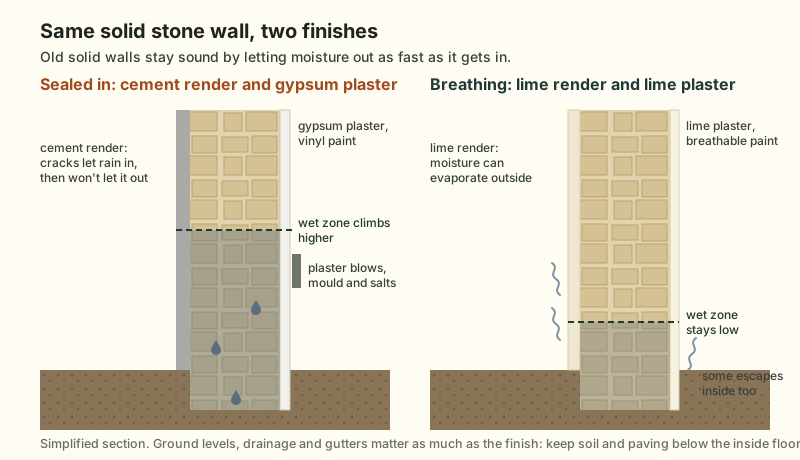
In an Oxford terrace or villa, the breathable route means:
- replacing hard cement render and repointing in lime;
- lowering soil or paving against the wall;
- replacing a floor membrane that pushes moisture into the wall base with a breathable floor, or cutting a breathing strip;
- lime plaster inside, finished with limewash or soft distemper.
A 2014 BRE study for the Council estimated half of Oxford's homes were built before 1944, so this applies across much of the city. It is how Oxford Damp Specialists approaches damp proofing in Oxford, and the guide to damp in old and listed buildings goes further.
Will a listed Oxford house need consent before rising damp is treated?
In most cases, yes. According to the Planning Portal, damp proofing a listed building will normally need listed building consent from the council. Oxford City Council's consent guidance applies consent to any internal or external work that would affect the building's special character, including repairs that replace significant fabric or swap in different materials.
Oxford has around 1,500 listed buildings, and the inside is listed as well as the outside. Unauthorised work is an offence, and the Council lists prosecution, an order to reverse the work, imprisonment or unlimited fines as possible outcomes. Applications carry no fee, and Historic England says councils should reach a decision within 8 weeks.
Under the joint position statement, adding permanent modern materials to a listed building is likely to need consent in advance. In Oxford's 18 conservation areas, the Planning Portal advises contacting the council about damp proofing, particularly if the outside will look different. Oxford Damp Specialists sets out in writing which parts of a job may need consent, so you can speak to the Council's heritage team before anything starts.
What does rising damp treatment cost, and why do national figures disagree?
Price guides vary widely, so read them as rough national yardsticks rather than quotes. According to Which? (5 May 2026), rising damp is potentially the dearest kind of damp to put right, and two Checkatrade guides arrive at very different totals.
| Publisher | Figure | Date shown |
|---|---|---|
| Checkatrade damp proofing guide | Injection around £100 a metre on average (range £60 to £200); a chemical DPC about £2,000 on average, within £1,000 to £3,000; retrofitting a physical DPC about £5,000 on average, within £2,500 to £7,500 | Prices November 2024 |
| Checkatrade damp proof course guide | Detached £1,500 to £2,000; semi-detached £500 to £800; terraced £280 to £370 | Undated |
| Homebuilding and Renovating cost guide | £195 per metre for a chemical DPC, replastering included | 9 April 2024 |
| Homebuilding and Renovating plastering guide | Gypsum £25 to £40 per m²; lime £70 to £100 per m² | 10 June 2025 |
The cheapest rising damp job is the one you do not need: lowering a path or cutting back a bridging render is usually a far smaller job than injection and replastering. Oxford Damp Specialists confirms its price after the survey, once the cause is known. Our guide to damp proofing costs has more yardsticks.
Common questions
Is rising damp real, or just overdiagnosed?
It is real but less common than often claimed. The English Housing Survey found it in only 1% of English homes, the rarest type, and RICS warns that it is frequently misdiagnosed.
Will the plaster need replacing after treatment?
Usually, where the old plaster is loaded with salts, because treatment stops the rise but leaves those salts behind. In older walls, lime plaster is normally the right replacement.
Can a listed building have a chemical damp-proof course?
Only with listed building consent where the work affects the building's character, as damp proofing normally does. In many old walls a breathable repair is the better answer in any case.
How long before a treated wall is dry enough to finish?
That depends on the wall. Advice ranges from plastering 14 days after injection to waiting six months or more, and a very damp wall may take 6 to 12 months to dry out.
Sources for this page
- EHS 2024 to 2025 housing quality, introduction and key findings. GOV.UK (MHCLG), 29 Jan 2026
- Damp and mould, consumer guide. RICS, 16 Jun 2025
- BS 6576:2005+A1:2012, diagnosis of rising damp and installation of chemical DPCs. BSI Knowledge, catalogue page; current
- Code of Practice for the Investigation and Control of Dampness in Buildings. Property Care Association, Mar 2017; hosted by Bath & NE Somerset Council
- What is rising damp? SPAB, undated
- Understanding dampness: from symptoms to sources, Prof Mike Parrett. RICS Built Environment Journal, 5 Nov 2026
- Understanding Decay in an Older Home. Historic England, undated
- Damp-proof course DPC. Designing Buildings Wiki, last edited 25 Aug 2026
- summary of BRE Digest 245, Rising damp in walls: diagnosis and treatment. Designing Buildings Wiki, BRE, 12 Oct 2007
- Rising damp treatments, Adam Snook. Which?, 26 May 2026
- Typical types of rising damp treatment. Property Care Association, undated
- How to treat damp in older houses, Douglas Kent of SPAB. Homebuilding & Renovating, 20 May 2020, updated 8 Apr 2024
- Replastering following insertion of a damp-proof course. Safeguard Europe (manufacturer), undated
- How soon can you plaster after damp proofing? Checkatrade, updated 18 Jul 2023
- Technical Advice Note 15 Heritage Retrofit Guidance, May 2024. Oxford City Council
- Step 2 Maintenance to save energy in historic buildings, undated. Oxford City Council / Oxford HEET
- Integrated Housing Stock Database. BRE for Oxford City Council, 23 Jan 2014
- Damp proofing. Planning Portal, undated, © 2026
- Listed building consent. Oxford City Council, page dated 12 Dec 2023
- Listed buildings in Oxford. Oxford City Council, page dated 12 Dec 2023
- A Guide for Owners of Listed Buildings. Historic England, undated
- Investigation of moisture and its effects on traditional buildings, joint position statement, 1st edn. RICS, Historic England and PCA, Sep 2022
- All conservation areas. Oxford City Council, directory, checked 12 Nov 2026
- How much does it cost to repair damp?, Adam Snook. Which?, 5 May 2026
- Damp proofing cost breakdown. Checkatrade, page updated 6 Apr 2025; prices Nov 2024
- Damp proof course cost breakdown. Checkatrade, no date in content; title says 2026
- How much does damp proofing cost? Homebuilding & Renovating, 9 Apr 2024
- How much does internal plastering cost?, Tim Phillips. Homebuilding & Renovating, 10 Jun 2025
Before you call
A few details let us narrow down the likely cause on the phone.
- Postcode and the rough age of the building
- Which rooms and walls, and how far up
- Whether wet weather or cold snaps change it
- Where any mould is growing
- Owner, tenant or buyer, and any deadline
Rising damp treatment outside Oxford
Need rising damp treatment outside the city boundary? Each town page below looks at that town's houses, ground and rivers, and our damp proofing in Oxford page explains how we work.
Worth reading first
Damp in old and listed buildings: what is safe to do?
Stone, soft brick and lime walls need to dry out, and the wrong fix, or work done without consent, can leave an Oxford house damper.
How much does damp proofing cost?
Damp proofing prices swing from a modest survey fee to thousands for a new damp course, and the right diagnosis decides which one you pay.
Related work
Damp surveys
Before you exchange, accept a retention or agree to injection work, find out where the water in that Oxford wall is really coming from.
Penetrating damp repairs
The patch that darkens every wet October usually starts at a gutter, chimney or crumbling joint, so we follow the rain from outside in.
Condensation and mould
Black mould behind the wardrobe is a symptom: we trace the cold surface, the weak extract fan and the humidity feeding it.
The rest of the list
Woodworm and rot treatment
Flight holes in an old joist can be long dead: we prove woodworm or rot is active and find the water before treating anything.
Basement and cellar tanking
Oxford sits on gravels where winter groundwater can lie under a metre down, so a dry cellar needs the right protection type.
Shall we call you instead?
Your name, number and the property postcode are all we need. A sentence about the room and the wall makes the first call quicker. Or ring 01865 537413.