Penetrating damp repairs in Oxford
Penetrating damp repairs in Oxford for owners, landlords and tenants with a wet patch that appears after rain. Oxford Damp Specialists follows the water from outside, puts right or arranges the repair to the gutter, joint, flashing or path that lets it in, and gives the wall time to dry out before redecoration.
Get a wet patch traced
Postcode, phone number and a word about the problem. We call back, ask a few questions, and book a visit if it needs one.
- Traced from roof down
- Lime pointing for old walls
- Source fixed before plaster
How do I know if a damp patch is penetrating damp?
If a patch spreads or darkens after rain and fades in dry spells, penetrating damp is the likeliest cause. Government health guidance describes it as water from outside entering through faults in a home's roof, walls, floors or windows. It is the second commonest kind of damp: the English Housing Survey for 2024-25 recorded it in 2% of English homes, between severe condensation at 3% and rising damp at 1%. In private rented homes the rate was 4%.
Other clues are a patch high on a wall or ceiling, around a window or chimney breast, or on one side of the house only. The PCA Code of Practice notes that readings from penetrating damp tend to rise towards the water source, which is how we track it. Outside, SPAB points to green staining as a sign of rain getting through.
Timing is a clue too. On the Met Office 1991 to 2020 averages for Oxford, the wettest months are October (73.18 mm) and November (71.47 mm), out of 681.55 mm a year, and November has the most rain days. A patch that returns every autumn deserves a look from outside.
Where does rain get into an old Oxford terrace?
Mostly at the features built to carry water away: gutters, downpipes, chimneys and the joints between materials. The PCA Code lists roof coverings, rainwater goods, render, pointing and window seals as the defects to check.
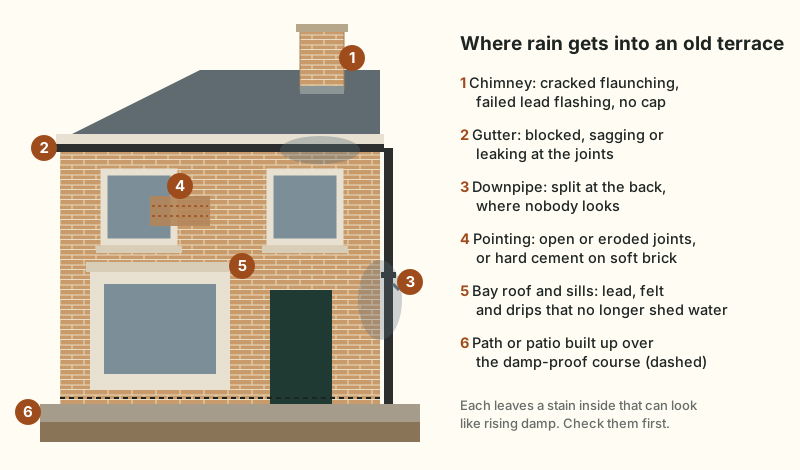
- Gutters and downpipes. SPAB lists blocked gutters that overflow, cracked downpipes and hopper heads that soak the wall, and leaking drains and gullies at its foot. Historic England says gutters should be sized for the rainfall expected.
- Chimneys and flashings. SPAB says acidic condensate in flues attacks mortar and salts can stay in a disused flue, and the PCA warns that flue gases leave sulphate contamination often misdiagnosed as penetrating damp. Failed flashings where the stack meets the roof let water run straight in.
- Parapets, bay roofs and sills. Small flat roofs over bays, parapet gutters and sills without a working drip all hold water against the wall.
- Pointing and render. Cracked cement render and eroded joints let rain through the face of the wall.
- Paths and patios. Paving raised against the wall lets splash and ground water bypass the damp-proof course, which should sit at least 150 mm clear of the ground.
Oxford Damp Specialists inspects from roof level down, and the first repair is usually outside. Raised paths overlap with rising damp treatment, because a bridged course is often mistaken for rising damp.
Should an old Oxford house be repointed and rendered in lime or cement?
On a solid-walled house, lime. Oxford's HEET guidance calls non-permeable cement unsuitable for rendering and pointing because it can trap moisture, and recommends lime. SPAB's technical director says fine cracks in cement pointing and render let moisture in, and strongly advises against colourless water-repellent treatments or plastic-based paints on old masonry.
Historic England explains why: cement render on the outside cracks with thermal movement and because it does not suit the wall behind, while lime renders and limewash reduce rain penetration and help walls dry. Historic England's guidance on energy-efficiency risks notes that water can become trapped behind a surface finish. SPAB's advice note on damp recommends repointing in a lime mix with no cement, and lime render where rain seriously penetrates.
Check before you change how a wall looks. In Jericho, an Article 4 direction restricts permitted development rights, including painting unpainted brick or stone, and listed houses need consent for work that affects their character. For scale, the national repointing yardsticks from Homebuilding & Renovating (4 May 2024, citing Checkatrade) run from £55 per m² for brick and £80 per m² for stone to £750 for a chimney, with scaffolding anywhere from £500 for a chimney to £2,500 to wrap a whole house. They are not our prices.
Can cavity wall insulation let rain through to the inside?
Yes, when the wall was unsuitable or the work was poor. A government consumer guide warns that poorly fitted cavity wall insulation can lead to damp and mould indoors as well as structural damage. The Energy Saving Trust says suitable walls are not exposed to driving rain, and that walls with damp patches should not be insulated until the damp is resolved. Which? adds that cavities should be at least 50 mm wide and clear of rubble.
In Oxford, a 2014 BRE study estimated that 34% of private-sector homes had insulated cavities, 37% uninsulated cavities and 29% solid walls. The Council's heritage retrofit guidance says early cavity walls built with bonding bricks should be treated as solid walls, because the cavity cannot be filled with insulation.
If you suspect the insulation, the government guide says to contact the firm that fitted it first, then the guarantee provider, which is often CIGA. Oxford Damp Specialists can establish whether the fill, a bridged cavity or something else is to blame, and put the evidence in writing.
How often should gutters be cleared on an Oxford period house?
At least twice a year, says Oxford's HEET maintenance check. With October and November the wettest months on Met Office averages, a clear-out after leaf fall, before the heaviest rain, catches the blockages that matter. The same check lists the signs of damp to watch for: white salt staining, dark patches and crumbling masonry.
A simple routine:
- clear gutters, hoppers and gullies, and watch downpipe joints in heavy rain;
- look for slipped slates or tiles, cracked flashings and open joints on chimneys;
- keep soil and paving well below the damp-proof course;
- check sills, bay roofs and parapet outlets.
For landlords this is a legal duty. Under section 11 of the 1985 Landlord and Tenant Act, a landlord must keep the structure and exterior in repair, and the Act spells out that this includes drains, gutters and external pipes. Shelter notes that penetrating damp from a defect such as a roof leak is the landlord's responsibility. Where mould has followed the wet patch, see our condensation and mould service too.
What should I do about damp walls after a flood or high groundwater in Oxford?
Find out where the water came from, then dry the building steadily before repairing it. Government guidance calls damp from flooding or leaking pipes traumatic damp, and says damp and mould mainly affect the lungs and airways.
In Oxford the water does not always come over the doorstep. A BGS and Environment Agency study found that a lot of the properties flooded in 2000 and 2003 suffered from groundwater only, including pre-war basements converted to living space, and that the gravel water table is typically less than 1 m below ground in winter. After 60.6 mm of rain on 19 and 20 July 2007, more than 200 properties flooded internally, and at New Hinksey the flooding came from groundwater emerging at the surface. During Storm Henk in January 2024, the Council said only 17 properties flooded, with temporary defences put up at Bullstake Close, Osney Island and Vicarage Lane.
After a flood, Oxford Damp Specialists maps how far moisture has spread, checks floor voids and timbers for the conditions that lead to wet and dry rot, and plans drying before any replastering. Water that keeps returning to a cellar is a basement tanking question. Oxfordshire Trading Standards warns about cold callers after storms and floods and advises getting at least three written quotes.
What does a penetrating damp repair involve, and what does it cost?
The repair is to the outside first, then the inside once the wall has dried. The joint position statement sets the order: fix obvious defects, allow monitoring and natural drying, reassess, and only then consider other treatments. That rules out tanking or injecting a wall that is wet because of a gutter.
- Trace the source from roof level down, following readings that climb towards it.
- Repair it: gutters, downpipes, pointing, render, flashings or ground levels.
- Let the wall dry, rechecking readings as it does.
- Make good inside, in lime on older walls.
Costs depend on the source and on access. Clearing a gutter is a small job, and Which? notes that clearing gutters may help some penetrating damp. Scaffolding and repointing are the bigger items (see the national yardsticks above), and Homebuilding & Renovating puts lime plastering at £70 to £100 per m² (10 June 2025). Oxford Damp Specialists confirms its price when you book, once the source is known. Our guide to damp proofing costs has more, and the Oxford damp proofing home page lists every service.
Common questions
If I rent, who is responsible for rain coming through the wall?
The landlord, where water gets in through the structure or exterior; the law counts drains, gutters and external pipes as part of that.
Is a water-repellent coating a good fix for a damp old wall?
Not on old masonry. SPAB strongly discourages water-repellent treatments and plastic-based paints on old walls; fixing the source and using lime works better.
Once the leak is repaired, how soon is the wall dry?
That depends on how thick the wall is, the weather and how long it stayed wet, so we recheck readings rather than guess. Nothing inside is replastered or decorated before the wall is dry.
Can filled cavities be the reason my wall is damp?
They can, where the wall faces driving rain, the cavity is narrow or full of rubble, or the work was poor. Go to the firm that fitted it first, then the guarantee provider, often CIGA.
Sources for this page
- Risks of energy efficiency interventions. Historic England, undated
- Understanding and addressing the health risks of damp and mould in the home. GOV.UK (OHID/DHSC, MHCLG, UKHSA), 7 Sep 2023, updated 1 Apr 2026
- EHS 2024 to 2025 housing quality, introduction and key findings. GOV.UK (MHCLG), 29 Jan 2026
- English Housing Survey 2024 to 2025, Chapter 1: housing quality. GOV.UK (MHCLG), published 29 Jan 2026
- Code of Practice for the Investigation and Control of Dampness in Buildings. Property Care Association, Mar 2017; hosted by Bath & NE Somerset Council
- What is rising damp? SPAB, undated
- Oxford location-specific long-term averages. Met Office, (1991–2020), checked 12 Nov 2026
- Technical Advice Note, Control of Dampness, Douglas Kent. SPAB, 2018; Edn 1 Rev 1, 2020
- Understanding Decay in an Older Home. Historic England, undated
- Damp-proof course DPC. Designing Buildings Wiki, last edited 25 Aug 2026
- Step 2 Maintenance to save energy in historic buildings, undated. Oxford City Council / Oxford HEET
- How to treat damp in older houses, Douglas Kent of SPAB. Homebuilding & Renovating, 20 May 2020, updated 8 Apr 2024
- Properties of Traditional Building Construction. Historic England, undated
- Oxford City Council Article 4 directions, checked 12 Nov 2026. MHCLG planning data register
- Listed building consent. Oxford City Council, page dated 12 Dec 2023
- How much does repointing cost? Homebuilding & Renovating, 4 May 2024
- Cavity wall insulation: consumer guide to issues arising from installations. GOV.UK (BEIS), Oct 2019
- Cavity wall insulation. Energy Saving Trust, undated
- Cavity wall insulation damp problems. Which?, 6 Oct 2026
- Integrated Housing Stock Database. BRE for Oxford City Council, 23 Jan 2014
- Technical Advice Note 15 Heritage Retrofit Guidance, May 2024. Oxford City Council
- Landlord and Tenant Act 1985, s.11. legislation.gov.uk, revised
- Damp and mould problems. Shelter England, updated 23 Jun 2026
- Environment Agency et al.), Investigating the interdependencies between surface and groundwater in the Oxford area, c.2007. Macdonald et al. (BGS
- Dixon, Newell, Hallaways (BGS/EA), Groundwater flooding within an urbanised floodplain, undated in text (post-July 2007). Macdonald
- Financial support for those affected by flooding. Oxford City Council news, (Storm Henk), undated on page
- Bad weather is the perfect storm for unscrupulous traders. Oxfordshire County Council news, 8 Oct 2024
- Investigation of moisture and its effects on traditional buildings, joint position statement, 1st edn. RICS, Historic England and PCA, Sep 2022
- How much does it cost to repair damp?, Adam Snook. Which?, 5 May 2026
- How much does internal plastering cost?, Tim Phillips. Homebuilding & Renovating, 10 Jun 2025
Before you call
A few details let us narrow down the likely cause on the phone.
- Postcode and the rough age of the building
- Which rooms and walls, and how far up
- Whether wet weather or cold snaps change it
- Where any mould is growing
- Owner, tenant or buyer, and any deadline
Penetrating damp repairs outside Oxford
Need penetrating damp outside the city boundary? Each town page below looks at that town's houses, ground and rivers, and our damp proofing in Oxford page explains how we work.
Worth reading first
How much does damp proofing cost?
Damp proofing prices swing from a modest survey fee to thousands for a new damp course, and the right diagnosis decides which one you pay.
Damp in old and listed buildings: what is safe to do?
Stone, soft brick and lime walls need to dry out, and the wrong fix, or work done without consent, can leave an Oxford house damper.
Related work
Damp surveys
Before you exchange, accept a retention or agree to injection work, find out where the water in that Oxford wall is really coming from.
Rising damp treatment
A tide-mark along the skirting is a clue, not a verdict: we prove rising damp, clear whatever bridges the course, and only then treat.
Condensation and mould
Black mould behind the wardrobe is a symptom: we trace the cold surface, the weak extract fan and the humidity feeding it.
The rest of the list
Woodworm and rot treatment
Flight holes in an old joist can be long dead: we prove woodworm or rot is active and find the water before treating anything.
Basement and cellar tanking
Oxford sits on gravels where winter groundwater can lie under a metre down, so a dry cellar needs the right protection type.
Shall we call you instead?
Your name, number and the property postcode are all we need. A sentence about the room and the wall makes the first call quicker. Or ring 01865 537413.