Updated 12 November 2026, with every source rechecked
Dry rot or wet rot: how do you tell them apart?
Found rot under a floor or behind a skirting board in Oxford? This guide explains how dry rot and wet rot differ, why both need taking seriously, what causes them in old solid-walled houses, and what proper treatment involves, starting with the water rather than the chemicals.
Book a damp survey
Postcode, phone number and a word about the problem. We call back, ask a few questions, and book a visit if it needs one.
How does dry rot differ from wet rot, and why does it matter?
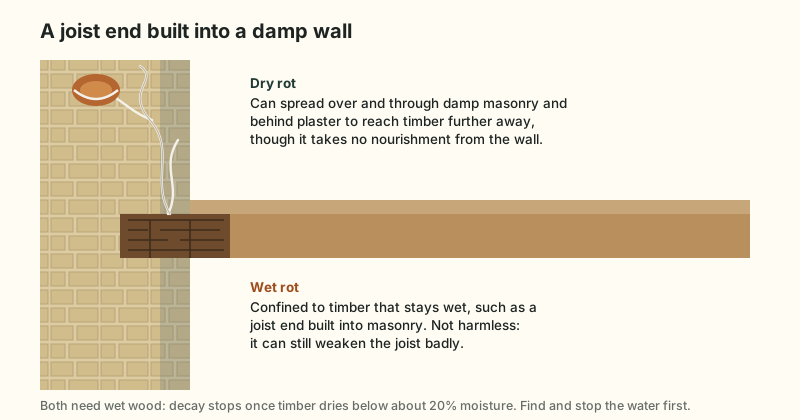
The real difference is how far the fungus can travel, not whether it does damage. According to the Property Care Association, dry rot is able to spread fairly fast when conditions suit it, growing over masonry to reach more timber. Wet rots are other fungi, usually confined to areas that are regularly wet or to wood built into masonry.
The PCA regards sorting rots into wet and dry as misleading, because wet rots need no more moisture than dry rot. BRE scientists write that decay will cease if the moisture content of the wood is reduced to below about 20 per cent.
Wet rot is not harmless. It weakens joists, floorboards and window frames, and the PCA's advice is that weakened timber should be removed and replaced. The difference is scope: wet rot repairs stay with the wet timber, while dry rot work has to follow the fungus wherever it has spread.
What signs show whether timber decay is dry rot or wet rot?
Look at what the fungus is doing beyond the wood. Dry rot sends strands across brick, stone and plaster: BRE notes that its strands are able to pass through and over brick and stone, and a PCA article on its biology says the growth spreads outwards over walls and behind plaster and flooring. Wet rot stays in or very close to the wet timber.
- Strands or sheets of growth on masonry next to timber point towards dry rot.
- A fruiting body on a wall or floor, shown at the end of the strands in the diagram below, is another dry rot sign.
- Soft, crumbling timber limited to a damp spot, such as a sill, a joist end or wood under a leak, fits wet rot.
Appearance only gets you so far. The PCA's timber surveyor exam includes identifying fungus or infestation in twelve timber samples, so before any firm inspects rot, check that the person doing it holds the PCA's CSTDB (formerly CSRT) qualification.
Can dry rot spread into dry timber?
No. Dry rot needs water from an outside source such as a leak, condensation or rising damp. A PCA article on its biology says the fungus can only grow in wood with a water content of over 20%, with no evidence that drier wood can be colonised through water carried along the strands.
BRE scientists Janice Carey and Colin Grant agree. The fungus's ability to conduct water is limited and can be negated by good ventilation, the water released as it breaks down wood is no different from any other wood-rotting fungus, and many outbreaks found in buildings died out once maintenance removed the water source.
So strands on a wall look alarming, but once the leak is fixed and the area dries, decay stops. If a quote relies chiefly on chemical spraying of walls, get a second opinion.
What causes wet rot and dry rot in older Oxford houses?
Water reaching timber that cannot dry, usually from an ordinary building defect. The PCA lists roof leaks, flooding, poor maintenance, poor ventilation, building defects and groundwater as sources to look for.
The Council's Heritage Retrofit Guidance says that up until the 1930s, Oxford houses were most commonly built with solid brick walls, and in those walls the ends of floor joists sit in pockets in the masonry. If the wall stays wet from a leaking gutter, failed pointing or a raised path, the joist end sits in damp brick, which is exactly where wet rot starts. Historic England notes that timber suspended ground floors can stay damp and decay.
- Air bricks. TAN 15 says that for suspended timber floors, air bricks and ventilation should not be covered up. Raised patios and soil heaped against a wall can block them.
- Gutters. The Council's heritage health check advises clearing gutters and downpipes at least twice a year.
- Groundwater. Across Oxford's floodplain the gravel aquifer is typically less than 1 m below ground in winter, so cellar and low-floor timbers need checking.
How are dry rot and wet rot treated properly?
Stop the water first, then remove decayed timber, and use chemicals only where they add something. The PCA says treatment must always start with an understanding of the cause, and that fungicides only protect vulnerable timber in the short term.
For wet rot, the PCA advises finding the moisture source, establishing the extent, and replacing weakened timber. Large or important timbers can be repaired by splicing or resin bonding if kept dry.
For dry rot, the PCA biology article says to repair sources of water ingress, ventilate and expose the area, and remove as much of the affected timber as feasible. BRE scientists question soaking masonry with fungicide, since it adds water, slows drying and risks salt efflorescence, and say chemicals must not be regarded as a substitute for getting the building dry. They add that removed timber worth keeping can be kiln-sterilised at just over 40°C for 15 minutes.
Historic timber needs the lightest touch that works. Oxford has around 1,500 listed buildings, and listed building consent covers any work, internal or external, that will affect the special character, including repairs that replace important fabric. Oxford Damp Specialists plans timber treatment to keep as much original timber as can safely stay, and flags where consent is likely to be needed. See also damp in old and listed buildings.
When do I need a specialist survey for wet or dry rot?
Whenever you find strands on masonry, soft or crumbling timber, or a floor that gives, because the visible patch may not show how far the decay goes. The PCA's damp Code says reports must highlight the consequences of dampness, especially fungal decay and insect attack.
Buyers should know that a RICS Level 2 surveyor does not lift floorboards, and should recommend further investigation if a problem is suspected. The 2022 joint position statement written jointly by RICS, the PCA and Historic England expects surveyors to declare any conflict of interest openly and remedial work to be proportionate. On a damp and timber survey, Oxford Damp Specialists traces the water source first, opens up only where the evidence points, and sets out repair options in writing.
How much does dry rot or wet rot treatment cost in the UK?
Nationally, MyBuilder's undated price guide puts dry rot treatment at £500 to £12,000 or more. A room needing structural repair costs between £1,500 and £5,000, and each replaced joist at £250 to £350. Wet rot runs from £500 to £1,000 when minor and £1,000 to £2,500 when moderate, rising past £3,000 when extensive. The same guide lists a timber survey at £200 to £500.
These are national yardsticks from a trade directory, not Oxford quotes or our prices. The figure moves with how far the decay has spread, how much floor or plaster must come up, and what it takes to cure the water source. Our price is confirmed when you book. See what damp proofing costs, or damp proofing in Oxford for everything we cover.
Common questions
Can wet rot be left alone because it is not dry rot?
No. Wet rot does not travel across masonry, but it can still weaken joists and floors enough that they need replacing.
Will fungicide treatment alone get rid of dry rot?
No. Decay stops when the timber dries, so the leak or damp has to be fixed first; fungicides only give short-term protection to vulnerable timber.
Is listed building consent needed for rot repairs in Oxford?
It can be. Listed building consent covers work that affects a building's special character, including repairs that replace important fabric, so check with Oxford City Council first.
Should buyers commission a timber survey when rot is suspected?
Yes. A RICS Level 2 survey does not lift floorboards, so a damp and timber survey before exchange is how you learn the extent and likely repair.
Sources for this page
- Wood rot. Property Care Association, © 2024
- Dry Rot and its Treatment in Historic Buildings, Janice Carey and Colin Grant, BRE. Building Conservation Directory, 1999
- Wet rot treatment. Property Care Association, © 2025
- Dealing with dry rot: insights from fungal biology, Sarah Watkinson Consulting. Property Care Association, undated
- CSTDB and CSDB examinations. Property Care Association, © 2025
- Technical Advice Note 15 Heritage Retrofit Guidance, May 2024. Oxford City Council
- Understanding Decay in an Older Home. Historic England, undated
- Step 2 Maintenance to save energy in historic buildings, undated. Oxford City Council / Oxford HEET
- Environment Agency et al.), Investigating the interdependencies between surface and groundwater in the Oxford area, c.2007. Macdonald et al. (BGS
- Listed buildings in Oxford. Oxford City Council, page dated 12 Dec 2023
- Listed building consent. Oxford City Council, page dated 12 Dec 2023
- Code of Practice for the Investigation and Control of Dampness in Buildings. Property Care Association, Mar 2017; hosted by Bath & NE Somerset Council
- Description of the RICS Home Survey, Level 2. RICS, undated PDF
- Investigation of moisture and its effects on traditional buildings, joint position statement, 1st edn. RICS, Historic England and PCA, Sep 2022
- Dry rot treatment cost. MyBuilder, undated
Before you call
A few details let us narrow down the likely cause on the phone.
- Postcode and the rough age of the building
- Which rooms and walls, and how far up
- Whether wet weather or cold snaps change it
- Where any mould is growing
- Owner, tenant or buyer, and any deadline
Want someone to look at it? Our damp proofing in Oxford page sets out what we survey, what we repair and where we work.
The work this guide touches on
Woodworm and rot treatment
Flight holes in an old joist can be long dead: we prove woodworm or rot is active and find the water before treating anything.
Damp surveys
Before you exchange, accept a retention or agree to injection work, find out where the water in that Oxford wall is really coming from.
Other guides
How much does damp proofing cost?
Damp proofing prices swing from a modest survey fee to thousands for a new damp course, and the right diagnosis decides which one you pay.
What does woodworm treatment cost?
Those tiny round holes in your floorboards may be decades old, so prove the beetles are alive before paying anyone to spray.
What does basement tanking cost?
Oxford's water table sits close beneath many cellars, so a tanking bill turns on where water comes from and how dry the room must be.
Why is there condensation in my bedroom?
Wet glass at dawn and black spots behind the wardrobe: why bedrooms condense worst, and the heating and airflow changes that stop it.
Awaab's Law explained: deadlines for fixing damp and mould
Named after a two-year-old whose death was caused by mould exposure, Awaab's Law sets repair deadlines that private renters are still waiting for.
Damp in old and listed buildings: what is safe to do?
Stone, soft brick and lime walls need to dry out, and the wrong fix, or work done without consent, can leave an Oxford house damper.
Shall we call you instead?
Your name, number and the property postcode are all we need. A sentence about the room and the wall makes the first call quicker. Or ring 01865 537413.