Updated 12 November 2026, with every source rechecked
Why is there condensation in my bedroom?
Streaming windows at dawn and black specks high in a bedroom corner point to condensation. Written for Oxford homeowners, landlords, students and tenants, this guide covers why bedrooms condense overnight, how to tell it from other damp, and what stops the mould returning.
Book a damp survey
Postcode, phone number and a word about the problem. We call back, ask a few questions, and book a visit if it needs one.
Why does condensation form in my bedroom overnight?
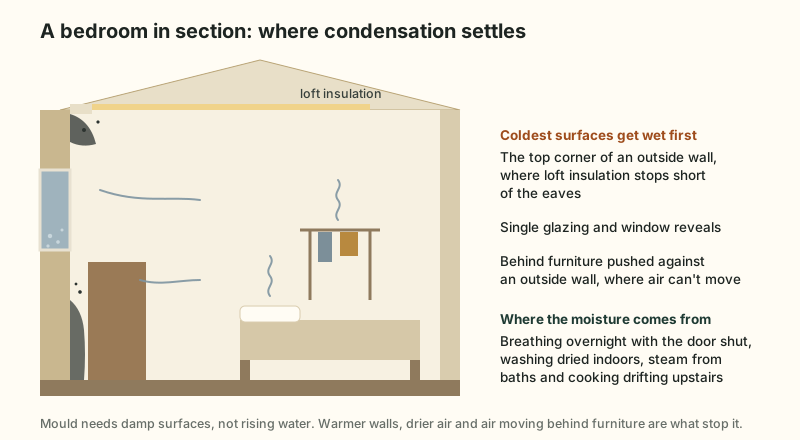
Bedrooms condense because warm, moist air meets cold surfaces for hours with little air moving. Two people asleep behind a closed door breathe moisture into a small room all night, and the Property Care Association's dampness code explains that condensation forms where a surface falls below the dew point, typically where air circulation is poor.
The coldest surfaces take it first: the glass, the outside wall, and the top corner where the ceiling meets an outside wall. If loft insulation stops short of the eaves, that corner stays colder and mould gathers there in a band. A wardrobe pushed tight against an outside wall traps still, cold air behind it, so mould can grow there unseen. Washing dried on a bedroom radiator adds more water still, which is why the NHBC leaflet on condensation advises against it.
Condensation is the commonest kind of damp in England. The English Housing Survey 2024-25 found severe condensation in 3% of homes. Penetrating damp showed up in 2% and rising damp in 1%.
Is it condensation, rising damp or penetrating damp on my bedroom wall?
Mould in the top corner of an upstairs bedroom is not rising damp, because rising damp is ground moisture moving up from the base of a wall. The PCA's code on investigating dampness notes that true rising damp commonly leaves a tide-mark, typically no higher than about 1 m above the floor, and that salts are usually absent where condensation is the cause.
- Condensation is worst in cold weather, sits on the surface, and gathers in corners, behind furniture and on glass, with black mould spotting.
- Penetrating damp is rain getting in through a defect, so the patch grows after wet weather and is wettest nearest the fault. Outside, SPAB points to green staining as a sign of rain penetration.
- Rising damp stays in the lower part of ground-floor walls.
Damp meters alone mislead. RICS advises caution about any surveyor or firm relying on a damp meter alone, and SPAB's technical director explains that one set of high readings can wrongly suggest rising damp when condensation is to blame. On a damp survey, Oxford Damp Specialists records room humidity and surface temperatures and checks the gutters and walls outside. If the patch follows the rain, see penetrating damp.
How do I stop condensation in my bedroom without new equipment?
Keep the bedroom steadily warm, give the moisture a way out, and move furniture off the outside walls. The NHBC advice for homeowners is simple:
- heat the whole home at a lower, steady temperature rather than leaving the bedroom cold;
- leave trickle vents open whenever the room is in use, including overnight;
- stand wardrobes and beds against internal walls, with a gap behind;
- run the bathroom extractor with the door shut while showering, and for about 20 minutes afterwards.
The government's HHSRS guide for landlords says inadequate heating will also contribute to damp and mould. A dehumidifier helps while the cause is found: Awaab's Law guidance gives a dehumidifier and specialist mould wash as an example of making a home safe while investigation continues.
If mould still returns through a cold spell, look for a cold spot, a missing fan or a hidden leak. That is the point to book a condensation and mould visit from Oxford Damp Specialists.
Which ventilation fixes bedroom condensation: extract fans, dMEV or PIV?
Start with the bathroom and kitchen, because moisture from showers and cooking drifts into bedrooms unless it is removed where it is made. BEAMA's guidance on Approved Document F, whose 2021 edition applies to work from 15 June 2022, sets minimum extract rates: at least 15 litres a second in a bathroom and 60 in a kitchen.
- dMEV uses several smaller extract units in different rooms, each running continuously.
- PIV blows filtered air from a loft-mounted fan into the home through a ceiling diffuser. It needs loft space, is not an extract ventilator and draws in cold loft air in winter, so kitchen and bathroom extraction must still meet Part F. BEAMA says PIV can still be used to achieve regulatory compliance if shown to ventilate adequately.
In older Oxford houses, changes must suit the walls. A BRE study for the Council found 50% of Oxford housing was built before 1944, and the Council's Heritage Retrofit Guidance warns that inappropriate alterations could lead to damp, mould or dry rot. Our guide to damp in old and listed buildings explains why.
As national yardsticks only, Checkatrade's guides give £250 to £350 (prices June 2026) for fitting a new extractor fan, and for PIV supply and installation £763 to £1,750 (prices May 2024). Our own price is confirmed when you book.
Is black mould in a bedroom bad for your health?
It can be, and bedrooms matter because people breathe that air all night. Government damp and mould guidance developed with UKHSA says damp and mould primarily affect the airways and lungs, and links them to around 5,000 cases of asthma and 8,500 lower respiratory infections in 2019. Children, older adults, pregnant women and people with respiratory conditions or weakened immune systems are among those at greater risk.
Small patches on hard surfaces can be cleaned with a mould and mildew product in preference to bleach, but the same guidance warns that cleaning off surface mould alone does not prevent it coming back. Dry glass is no all-clear either: the PCA Code notes that mould can grow below the humidity needed for condensation, citing 80% relative humidity at external walls from BS 5250.
How do Oxford students and shared-house tenants report condensation and mould?
Tell the landlord in writing, keep photos and dates, and allow 14 days; if nothing happens, report it to Oxford City Council's Residential Regulation Team. That is the route on the Council's damp and mould reporting page, and it can lead to an inspection and an improvement notice. The same page states that all privately rented homes in Oxford must be licensed.
The Council estimates that 1 in 5 residents live in an HMO, and there are 34,945 full-time students at the two universities. A new city-wide HMO licensing scheme came into force on 25 June 2026, and by the end of selective licensing's third year, Council inspections since September 2022 had found damp and mould in 424 properties.
Condensation is not automatically the tenant's fault. The health guidance says landlords cannot reasonably pin damp and mould on how tenants live, and Shelter explains that condensation can be the landlord's responsibility where it is caused by an unfixed repair or a design flaw such as inadequate ventilation. Oxford Damp Specialists can set out in writing whether the mould is condensation, a leak or both. Social tenants will find repair timescales in our Awaab's Law guide.
When is bedroom condensation worst in Oxford?
December to February, when frosty nights chill outside walls and glass the most. Met Office 1991 to 2020 averages for Oxford record 8.6 air frost days in December, 8.4 in January and 7.5 in February, out of about 34 a year. November has the most rain days, which is when washing ends up drying indoors. For everything else we cover, see damp proofing in Oxford.
Common questions
Who has to fix condensation in a rented bedroom?
It can be either. Condensation can be the landlord's responsibility where it comes from an unfixed repair, poor heating or a design flaw such as inadequate ventilation.
Is a dehumidifier enough to sort out bedroom condensation?
It lowers the moisture while the cause is found, but it does not fix a cold corner, a missing extractor fan or a leak.
Is a damp survey worth it for bedroom mould?
Not always. If steady heating, open trickle vents and moving furniture stop it, condensation was the cause. If it comes back, spreads after rain or stays near the floor downstairs, book a damp survey.
What time of year should bedroom condensation be inspected?
December to February in Oxford, when condensation is forming and easier to measure. Use the quote form to arrange a visit.
Sources for this page
- Code of Practice for the Investigation and Control of Dampness in Buildings. Property Care Association, Mar 2017; hosted by Bath & NE Somerset Council
- Condensation in your home. NHBC, 2024 leaflet
- EHS 2024 to 2025 housing quality, introduction and key findings. GOV.UK (MHCLG), 29 Jan 2026
- What is rising damp? SPAB, undated
- Damp and mould, consumer guide. RICS, 16 Jun 2025
- How to treat damp in older houses, Douglas Kent of SPAB. Homebuilding & Renovating, 20 May 2020, updated 8 Apr 2024
- Landlord and agent guide to the HHSRS. GOV.UK (MHCLG), 23 Jun 2026, updated 16 Sep 2026
- Awaab's Law: guidance for social landlords, timeframes for repairs. GOV.UK (MHCLG), 17 Oct 2025, updated 16 Jul 2026
- Guidance on Part F of the Building Regulations for dwellings in England. BEAMA, 2022; ADF 2021 edn
- What is dMEV? Homebuilding & Renovating, 9 Jan 2024
- Positive Input Ventilation explained. Homebuilding & Renovating, 9 Sep 2021, updated 12 Jul 2024
- Integrated Housing Stock Database. BRE for Oxford City Council, 23 Jan 2014
- Technical Advice Note 15 Heritage Retrofit Guidance, May 2024. Oxford City Council
- Extractor fan installation cost. Checkatrade, prices June 2026
- PIV installation cost. Checkatrade, prices May 2024
- Understanding and addressing the health risks of damp and mould in the home. GOV.UK (OHID/DHSC, MHCLG, UKHSA), 7 Sep 2023, updated 1 Apr 2026
- Report damp and mould in a private rented or housing association home. Oxford City Council, page dated 16 Jul 2026
- HMO licensing background. Oxford City Council, page dated 8 Dec 2023
- Key facts about Oxford. Oxford City Council, undated (cites mid-2023 ONS)
- Additional Licensing. Oxford City Council, (HMOs), updated 2026
- Selective Licensing Scheme 2022 – Year 3 progress report. Oxford City Council, (Sep 2024–Aug 2025), page dated 7 Apr 2026
- Damp and mould problems. Shelter England, updated 23 Jun 2026
- Oxford location-specific long-term averages. Met Office, (1991–2020), checked 12 Nov 2026
Before you call
A few details let us narrow down the likely cause on the phone.
- Postcode and the rough age of the building
- Which rooms and walls, and how far up
- Whether wet weather or cold snaps change it
- Where any mould is growing
- Owner, tenant or buyer, and any deadline
Want someone to look at it? Our damp proofing in Oxford page sets out what we survey, what we repair and where we work.
The work this guide touches on
Condensation and mould
Black mould behind the wardrobe is a symptom: we trace the cold surface, the weak extract fan and the humidity feeding it.
Damp surveys
Before you exchange, accept a retention or agree to injection work, find out where the water in that Oxford wall is really coming from.
Other guides
How much does damp proofing cost?
Damp proofing prices swing from a modest survey fee to thousands for a new damp course, and the right diagnosis decides which one you pay.
What does woodworm treatment cost?
Those tiny round holes in your floorboards may be decades old, so prove the beetles are alive before paying anyone to spray.
What does basement tanking cost?
Oxford's water table sits close beneath many cellars, so a tanking bill turns on where water comes from and how dry the room must be.
Dry rot or wet rot: how do you tell them apart?
Strands creeping over brickwork or a soft joist end: how to read the signs of rot, and why the water decides the repair.
Awaab's Law explained: deadlines for fixing damp and mould
Named after a two-year-old whose death was caused by mould exposure, Awaab's Law sets repair deadlines that private renters are still waiting for.
Damp in old and listed buildings: what is safe to do?
Stone, soft brick and lime walls need to dry out, and the wrong fix, or work done without consent, can leave an Oxford house damper.
Shall we call you instead?
Your name, number and the property postcode are all we need. A sentence about the room and the wall makes the first call quicker. Or ring 01865 537413.