Basement and cellar tanking in Oxford
Basement tanking and cellar waterproofing in Oxford for homeowners storing in, converting or drying out a cellar. We assess the groundwater risk, match the BS 8102 protection type and grade to how the space will be used, and plan the maintenance a pumped system needs.
Tell us about the cellar
Postcode, phone number and a word about the problem. We call back, ask a few questions, and book a visit if it needs one.
- BS 8102 Types A, B, C
- Designed for shallow groundwater
- Pumps planned for servicing
What do Types A, B and C mean in BS 8102 basement waterproofing?
BS 8102:2022 recognises three forms of protection for structures below ground. Type A is waterproofing barrier materials applied to the structure, which is what most people mean by tanking. Type B is structurally integral watertight construction, where the structure itself keeps water out. Type C is drained cavity construction, which allows water into the structure but collects it and drains it away from the occupied areas.
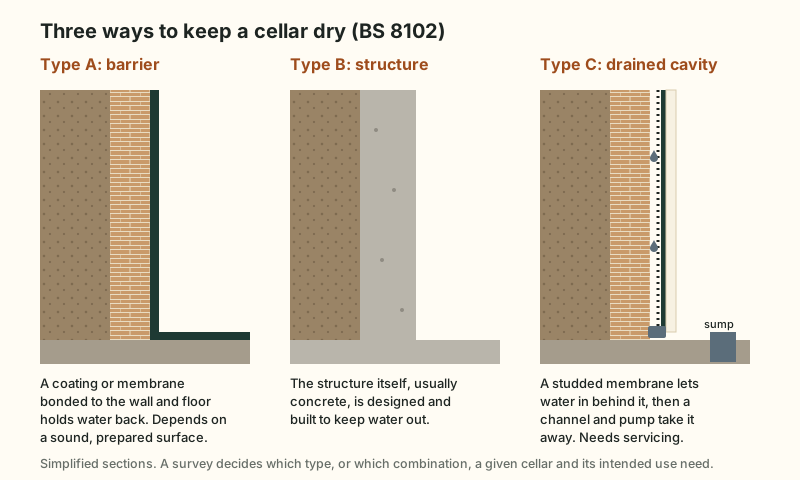
The current edition, BS 8102:2022, was published on 31 March 2022, replacing the 2009 version; it clarified the grades and added guidance on the need for experienced, competent contractors for waterproofing installations. Approved Document C recommends using BS 8102 to design basements where walls and floors are subject to water pressure.
A cellar wall is not a rising damp job. BS 6576, the code of practice for chemical damp-proof courses, excludes walls below ground or under hydrostatic pressure and leaves them to BS 8102.
Which BS 8102 grade suits a storage cellar, and which suits a bedroom?
Start from how the room will be used. As quoted by The Concrete Centre, the grades in BS 8102:2022 read:
- Grade 1a: "Seepage and damp areas from internal and external sources are tolerable".
- Grade 1b: "No seepage. Damp areas from internal and external sources are tolerable."
- Grade 2: "No seepage is acceptable." "Damp areas as a result of internal air moisture/condensation are tolerable".
- Grade 3: "No water ingress or damp areas is acceptable."
One waterproofing consultancy's summary of the grades gives example uses: Grade 1b for ventilated storage, Grade 2 for workshops and Grade 3 for habitable accommodation, offices and archives. These are not the standard's own words, but on that reading a cellar becoming a bedroom or home office points to Grade 3, while a ventilated store may need only 1b.
Why does groundwater get into cellars and basements in Oxford?
Because much of Oxford sits on a shallow gravel aquifer connected to its rivers. A British Geological Survey and Environment Agency study describes about 1 m of silty clay over about 5 m of sands and gravels on the floodplain, with Oxford Clay below and the city centre on older gravel terraces. The water in those gravels is typically less than 1 m below ground in winter and about 2 m in summer.
That has flooded basements with no river overtopping. The study says "a lot of properties only suffered from groundwater flooding", including pre-war basements later converted to living space. After 60.6 mm of rain on 19 and 20 July 2007, more than 200 properties flooded internally, and at New Hinksey a BGS and Environment Agency paper concluded "the flooding was caused by the emergence of groundwater at surface".
Around Beaumont Street, Walton Street and Wellington Square, the Council notes that many terraces also have basements. Mid-1860s red-brick terraces on Iffley Road are recorded as 3-storey, plus basement, on a river terrace beside the Cherwell and Thames floodplains. In Jericho the water table is near the surface, so some houses have only a shallow lower ground floor. That ground shapes damp proofing in Oxford below floor level.
Will the Oxford Flood Alleviation Scheme keep my cellar dry?
Not yet, because it has not been built. The Environment Agency scheme is about 5 km long, from just north of Botley Road to Kennington, and its stated aim is to reduce flood risk from the River Thames. On 16 May 2025 the Council announced that the Environment Secretary had confirmed the compulsory purchase order.
On timing, the sources differ. The Environment Agency's May 2025 newsletter said construction would start in late 2026; trade press reported in September 2026 that the main works contract had been awarded, with construction due to begin in 2027 and last about five years. Neither shows work under way yet.
The scheme targets river flooding; a cellar below a winter water table still needs its own protection, so a survey should consider the groundwater, not just the flood map.
Does a cavity drain membrane and sump pump need regular servicing?
Yes. LABC notes that under Approved Document C a Type C system "must be accessible for servicing and maintenance". The Property Care Association says seepage is typically removed by a mechanical sump pump system, that maintenance is "paramount to its long term success", and that systems should be serviced at least annually, with the first visit within three months of commissioning.
Pumps must be checked, tested and properly commissioned. Where winter groundwater sits close below the floor, a pump that fails quietly is the weak point, so sump access and servicing should be settled before the work is agreed.
Tanking has a different weak point. SPAB describes it as expensive and reliant on faultless workmanship, and prefers a pumped sump for cellars.
Do I need Building Regulations approval to convert a cellar into a habitable room?
Yes. According to the Planning Portal, Building Regulations cover both new basements and conversions, including escape from fire, ventilation and damp proofing. Approved Document C points to BS 8102 for walls and floors under water pressure, and LABC notes that the dutyholder or person carrying out the work is responsible for compliance.
Planning permission is separate: turning a cellar that already exists into a room is unlikely to require it, though occasionally it does; excavating a new one probably will. The general exemption for interior works does not cover works begun after 5 December 1968 that add space underground, so digging down to gain height deserves a check with the Council first.
Before converting, a damp survey shows whether water comes through the walls, the floor or a penetrating damp defect above ground.
Is consent needed to waterproof a cellar under a listed Oxford house?
Probably, if the work affects the building's special character. Oxford City Council says that the inside as well as the outside of a building is listed, and that consent covers any work, internal or external that will affect its special character. The Joint Position Statement says introducing permanent modern materials is likely to require prior Listed Building consent.
Unauthorised works are an offence, with prosecution, an order to reverse the work, imprisonment or unlimited fines as possible outcomes. There is no application fee.
SPAB's technical director also says tanking is not recommended in old buildings, and SPAB notes gypsum plaster must be removed for a ventilated dry lining. In a listed cellar Oxford Damp Specialists starts with drainage, ventilation and the least invasive option, and asks the Council about consent before any membrane goes on. See damp in old and listed buildings.
What does basement tanking cost, and what should I ask a firm?
These are national yardsticks from other publishers, not our prices.
| Work | National range | Source |
|---|---|---|
| Cellar or basement tanking | £100 to £200 per m², average £125 | Checkatrade, prices Nov 2024 |
| Cellar tanking, small to large cellars | From £40 per m² to £80 per m² or more | MyBuilder, undated |
| Cementitious tanking | £60 to £120 per m² | MyBuilder, 2026 figures |
| Cavity drain system | £80 to £150 per m² | MyBuilder, 2026 |
| Sump pump installation | £500 to £1,500 | MyBuilder, 2026 |
| Typical 20 m² cellar conversion | £30,000 to £50,000 | MyBuilder, 2026 |
Oxford Damp Specialists confirms the price when you book, once the groundwater risk, grade and access are known. The basement tanking cost guide explains what moves it.
When comparing firms, check whether the designer has passed the PCA CSSW examination (Certificated Surveyor in Structural Waterproofing), a qualification aimed at surveyors who work out how water is getting into below-ground structures and specify how to keep it out. Ask them to state the BS 8102 type and grade they are designing to, and who will service the pump.
Common questions
Could my cellar become a bedroom once it is waterproofed?
Yes, if it is designed to BS 8102 for habitable use, which points to Grade 3, and the conversion meets Building Regulations on fire escape, ventilation and damp proofing.
For an old cellar, which is better: a cavity drain or tanking?
Often a cavity drain. SPAB prefers a pumped sump for cellars and says tanking relies on faultless workmanship. The trade-off is that the pump needs servicing at least once a year.
Will converting my cellar need planning permission?
Using a cellar you already have is unlikely to require planning permission, but excavating a new basement probably will. Building Regulations apply either way.
How often should a cellar sump pump be serviced?
At least once a year, with the first visit within three months of commissioning, according to the PCA, and the pump must be checked, tested and properly commissioned.
Sources for this page
- Out of sight, out of mind? Protect below-ground structures from the power of water. BSI blog, undated
- Basement waterproofing and BS 8102: how to achieve compliance with the Building Regulations. LABC, 11 Dec 2015
- BS 8102:2022, Protection of below ground structures against water ingress. BSI Knowledge, 31 Mar 2022; catalogue page
- BS 6576:2005+A1:2012, diagnosis of rising damp and installation of chemical DPCs. BSI Knowledge, catalogue page; current
- Watertight concrete structures to BS 8102:2022. The Concrete Centre, 9 May 2022
- BS 8102 Table 2 performance grades. CLW (waterproofing consultancy), undated
- Environment Agency et al.), Investigating the interdependencies between surface and groundwater in the Oxford area, c.2007. Macdonald et al. (BGS
- Dixon, Newell, Hallaways (BGS/EA), Groundwater flooding within an urbanised floodplain, undated in text (post-July 2007). Macdonald
- Central Conservation Area Appraisal – Character Zone 7, 19th-century Residential Quarter, undated. Oxford City Council
- Conservation Area Appraisal: St Clement's & Iffley Road. Oxford City Council, Feb 2009
- Jericho Conservation Area Designation Study. Oxford City Council, Oct 2010
- OFAS Why do we need a large flood scheme in Oxford?, checked 12 Nov 2026. Environment Agency Engagement HQ
- New scheme in Oxford to protect every home and business from risk of River Thames flooding. Oxford City Council news, 16 May 2025
- Oxford Flood Alleviation Scheme newsletter. Environment Agency, May 2025
- Graham wins £220m Oxford 5km flood defence job. Construction Enquirer, 15 Sep 2026
- Key considerations for Type C waterproofing. Property Care Association, 31 May 2019
- Technical Advice Note, Control of Dampness, Douglas Kent. SPAB, 2018; Edn 1 Rev 1, 2020
- Basement conversion, planning permission and building regulations. Planning Portal, undated
- Town and Country Planning Act 1990, s.55. legislation.gov.uk, revised
- Listed buildings in Oxford. Oxford City Council, page dated 12 Dec 2023
- Listed building consent. Oxford City Council, page dated 12 Dec 2023
- Investigation of moisture and its effects on traditional buildings, joint position statement, 1st edn. RICS, Historic England and PCA, Sep 2022
- How to treat damp in older houses, Douglas Kent of SPAB. Homebuilding & Renovating, 20 May 2020, updated 8 Apr 2024
- Damp proofing cost breakdown. Checkatrade, page updated 6 Apr 2025; prices Nov 2024
- Cost of tanking a cellar. MyBuilder, undated
- Cellar conversion cost. MyBuilder, 2026 figures
- CSSW examination. Property Care Association, undated
Before you call
A few details let us narrow down the likely cause on the phone.
- Postcode and the rough age of the building
- Which rooms and walls, and how far up
- Whether wet weather or cold snaps change it
- Where any mould is growing
- Owner, tenant or buyer, and any deadline
Basement and cellar tanking outside Oxford
Need basement tanking outside the city boundary? Each town page below looks at that town's houses, ground and rivers, and our damp proofing in Oxford page explains how we work.
Worth reading first
What does basement tanking cost?
Oxford's water table sits close beneath many cellars, so a tanking bill turns on where water comes from and how dry the room must be.
How much does damp proofing cost?
Damp proofing prices swing from a modest survey fee to thousands for a new damp course, and the right diagnosis decides which one you pay.
Related work
The rest of the list
Damp surveys
Before you exchange, accept a retention or agree to injection work, find out where the water in that Oxford wall is really coming from.
Rising damp treatment
A tide-mark along the skirting is a clue, not a verdict: we prove rising damp, clear whatever bridges the course, and only then treat.
Penetrating damp repairs
The patch that darkens every wet October usually starts at a gutter, chimney or crumbling joint, so we follow the rain from outside in.
Condensation and mould
Black mould behind the wardrobe is a symptom: we trace the cold surface, the weak extract fan and the humidity feeding it.
Shall we call you instead?
Your name, number and the property postcode are all we need. A sentence about the room and the wall makes the first call quicker. Or ring 01865 537413.