Updated 12 November 2026, with every source rechecked
Damp in old and listed buildings: what is safe to do?
Old stone, brick and lime walls in Oxford need a different approach to damp. This guide explains why, which modern fixes can make things worse, how to find and treat the cause safely, and when listed building consent or conservation area rules apply.
Book a damp survey
Postcode, phone number and a word about the problem. We call back, ask a few questions, and book a visit if it needs one.
Why do solid stone and brick walls in Oxford handle moisture differently?
Traditional solid walls take in moisture and let it dry out again, rather than keeping it out. Historic England says traditional materials "have the capacity to absorb, store and later release moisture and heat", and that many historic buildings "would not have been built with a damp-proof course".
The 2022 joint position statement defines traditional buildings as those with "solid walls built from permeable materials", including lime-based mortars, plasters and renders, with no date cut-off.
Much of Oxford is built this way. The council's Heritage Retrofit Guidance (TAN 15, May 2024) says older buildings "need to breathe" and that "Up until the 1930s, house construction was most commonly in brick solid wall construction", mostly with lime mortars and plasters. A 2014 BRE study for the council estimated (a modelled figure) that 15,149 private-sector homes (29%) had solid walls.
Historic England says poorer Headington Freestone quarried from the early 18th century weathered badly: it "develops a hard, blackish crust that blisters and exfoliates", and many such buildings were re-faced with more durable stone such as Clipsham.
Can cement render, modern paint or the wrong plaster make an old wall damper?
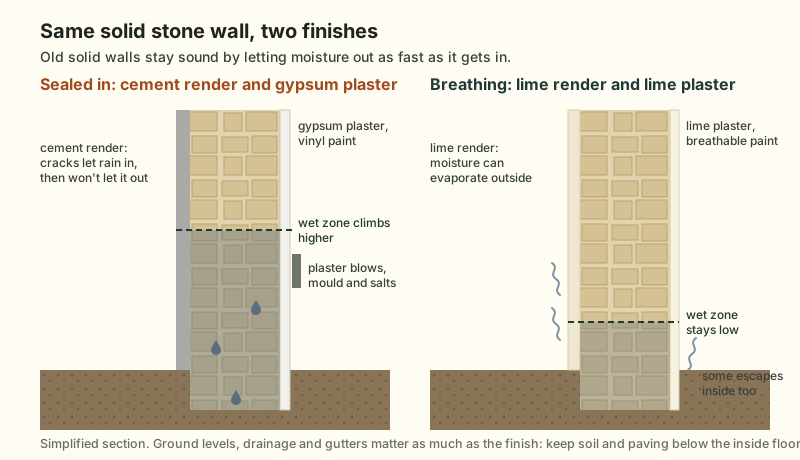
Yes, because they slow or stop the wall drying out. Historic England says external cement render "cracks due to thermal movement and incompatibility with the substrate", while lime mortars, renders and plasters keep their permeable properties. When impermeable materials are used, water "can become trapped behind the surface finish, causing the wall to stay saturated".
SPAB's Control of Dampness advice note says hard cement renders "increase the likelihood of interstitial condensation" and hinder evaporation, and that impermeable plastic-based materials trap moisture. Its technical director, writing in Homebuilding and Renovating, calls colourless water-repellent treatments or plastic-based paints on old masonry "strongly inadvisable", and recommends lime plaster for replastering rather than anti-sulphate or renovating plasters.
Oxford's HEET health check lists cement that is not water-permeable among the materials incompatible with traditional walls.
Are injected damp-proof courses and tanking safe in old walls?
Often they are not, and they are rarely the right first step. SPAB's starting position is against retrofitting DPCs in buildings older than roughly 1919, warning that, inappropriately installed in such a building, they can be damaging, ineffective and an unnecessary expense. It accepts a role where irreversible alterations mean the building now works as a modern sealed structure. Where a physical DPC cannot be fitted, it points to BRE guidance favouring methods that carry third-party certification, and says chemical injection is currently the only one that does.
SPAB's technical director says chemical DPCs are "not suitable candidates" for flint or granite walls or walls with rubble-filled voids, and does not recommend tanking in old buildings. SPAB adds that tanking is expensive and relies on "faultless workmanship".
RICS adds that original damp-proof courses very seldom fail, and that in older solid-walled buildings damp-proofing measures "may not be appropriate and may exacerbate damp issues". Oxford's HEET check warns there may be issues with adding a damp course to some traditional walls.
Oxford Damp Specialists recommends rising damp treatment only where testing proves rising damp and the wall suits it.
How should damp in an old building be investigated, according to the 2022 joint statement?
Find and fix the cause in stages, before any treatment. The joint position statement, written by Historic England, RICS and the PCA (Property Care Association) and adopted by SPAB and others, sets the order: fix obvious defects, allow monitoring and natural drying, reassess, and only then consider other treatments.
Inspection should be non-invasive first, with invasive work only "if it is deemed necessary". Diagnosis should address causes "rather than focusing on symptoms", any conflict of interest must be declared, and repairs should be proportionate and "minimise the impact on heritage value and significance". It lists BS 7913, the guide to the conservation of historic buildings among the standards an investigator should know.
Historic England sums it up: "Moisture in buildings is only a problem when there is too much of it". RICS advises asking for a survey that complies with the 2022 statement.
Our damp survey follows that order, outside first. Because we also carry out repairs, our report says so, as the statement asks.
Which maintenance jobs come first on a damp old house?
Gutters, downpipes, drains and ground levels come before any damp treatment. Historic England says gutters should be kept clear and "large enough for the rainfall levels predicted", and that "external levels can build up over many years", opening moisture routes that were not originally possible. RICS advises against expensive damp-proofing before routine maintenance.
Oxford's HEET health check advises clearing gutters and downpipes at least twice a year, and lists white salt staining, dark patches and crumbling masonry as signs of damp. TAN 15 says air bricks and ventilation under suspended timber floors "should not be covered up".
SPAB's remedies include repointing "normally using a lime-based mix (without cement)", lime render where rain seriously penetrates, limewash, and in some cases French drains to "help control below-ground dampness".
Rain getting in is covered under penetrating damp.
Is listed building consent needed to treat damp in a listed house?
Usually, yes, if the work could affect the building's character, and that includes the inside. According to the Planning Portal, putting in damp proofing will normally need listed building consent from the council.
Under section 7 of the 1990 Act on listed buildings and conservation areas, nobody may alter a listed building in a way that affects its character as a building of special architectural or historic interest without authorisation. Section 9 makes breaching that an offence, punishable by up to six months' imprisonment or a fine, or both, on summary conviction, and up to two years or a fine, or both, on indictment.
Listing "covers a whole building, including the interior" unless parts are explicitly excluded. Oxford City Council's listed building consent page covers "Any work, internal or external, that will affect the special character", including repairs that replace important fabric or use different materials.
Like-for-like repairs are less clear. A 2008 Building Conservation Directory article says they "are encouraged and can generally be carried out without consent", yet "even replacing a single stone is, technically, an alteration". The Historic England and Planning Portal pages cited here set out no like-for-like rule, so ask the council first.
There is no fee for a listed building consent application, and work is only authorised from the date consent is given. A council can insist unauthorised work is reversed. Oxford has "around 1,500 listed buildings"; its Urban Design and Heritage Team (heritage@oxford.gov.uk) gives pre-application advice as a paid service.
What damp work needs permission on an unlisted house in an Oxford conservation area?
Inside work generally needs no planning permission; outside changes may. Under section 55(2)(a) of the Town and Country Planning Act 1990, works that affect only the interior, or do not materially affect the external appearance, are not "development". Listed building consent is a separate regime.
Outside, Historic England says external changes such as stone cladding need planning permission in a conservation area, and Article 4 directions "restrict work that wouldn't normally require planning permission". The Planning Portal advises contacting the council about damp proofing, "particularly if the external appearance of the building will be impacted".
Oxford has 18 conservation areas. The national Article 4 register lists a Jericho direction from 31 March 2011 that restricts permitted development rights, including painting unpainted brick or stone; the Osney Town Article 4 Direction 1993, which started on 1 January 1994; and a city-wide direction on houses in multiple occupation from 25 February 2012.
Not sure what applies? Oxford Damp Specialists can survey the wall and set out the proposed repair in writing for you to take to the council. See also damp proofing in Oxford.
Common questions
Does Oxford charge for a listed building consent application?
No. There is no fee for a listed building consent application, though the council's pre-application advice is a paid service.
Is injecting a damp-proof course into a listed building allowed?
Only with consent in most cases, and SPAB's starting position is against retrofitting damp-proof courses in houses older than roughly 1919. Prove the cause first with a damp survey.
Is permission needed to replaster inside an unlisted house in a conservation area?
Generally not: interior-only work is not development under planning law. If the house is listed, the inside is covered too, so consent may be needed.
What are the consequences of damp work on a listed building without consent?
It is a criminal offence, and the council can insist the work is reversed. Consent only covers work from the date it is given.
Sources for this page
- Properties of Traditional Building Construction. Historic England, undated
- Understanding Decay in an Older Home. Historic England, undated
- Investigation of moisture and its effects on traditional buildings, joint position statement, 1st edn. RICS, Historic England and PCA, Sep 2022
- Technical Advice Note 15 Heritage Retrofit Guidance, May 2024. Oxford City Council
- Integrated Housing Stock Database. BRE for Oxford City Council, 23 Jan 2014
- Oxfordshire: Building Stones of England. Historic England, May 2023 edition
- Risks of energy efficiency interventions. Historic England, undated
- Technical Advice Note, Control of Dampness, Douglas Kent. SPAB, 2018; Edn 1 Rev 1, 2020
- How to treat damp in older houses, Douglas Kent of SPAB. Homebuilding & Renovating, 20 May 2020, updated 8 Apr 2024
- Step 2 Maintenance to save energy in historic buildings, undated. Oxford City Council / Oxford HEET
- What is rising damp? SPAB, undated
- Damp and mould, consumer guide. RICS, 16 Jun 2025
- BS 7913:2013, Guide to the conservation of historic buildings. BSI Knowledge, 31 Dec 2013; catalogue page
- Investigation of Moisture and its Effects on Traditional Buildings. Historic England, undated web page
- Damp proofing. Planning Portal, undated, © 2026
- Planning (Listed Buildings and Conservation Areas) Act 1990, s.7. legislation.gov.uk, revised
- Planning (Listed Buildings and Conservation Areas) Act 1990, s.9. legislation.gov.uk, revised
- A Guide for Owners of Listed Buildings. Historic England, undated
- Listed building consent. Oxford City Council, page dated 12 Dec 2023
- Conservation consent, Jonathan Taylor. Building Conservation Directory, 2008
- Listed building consent. Planning Portal, undated
- Listed buildings in Oxford. Oxford City Council, page dated 12 Dec 2023
- Town and Country Planning Act 1990, s.55. legislation.gov.uk, revised
- Conservation area home owner tips. Historic England, undated
- What Permission Might I Need to Make Changes to My Older Home? Historic England, undated
- All conservation areas. Oxford City Council, directory, checked 12 Nov 2026
- Oxford City Council Article 4 directions, checked 12 Nov 2026. MHCLG planning data register
- Jericho, checked 12 Nov 2026. Oxford City Council, Conservation Area
Before you call
A few details let us narrow down the likely cause on the phone.
- Postcode and the rough age of the building
- Which rooms and walls, and how far up
- Whether wet weather or cold snaps change it
- Where any mould is growing
- Owner, tenant or buyer, and any deadline
Want someone to look at it? Our damp proofing in Oxford page sets out what we survey, what we repair and where we work.
The work this guide touches on
Rising damp treatment
A tide-mark along the skirting is a clue, not a verdict: we prove rising damp, clear whatever bridges the course, and only then treat.
Penetrating damp repairs
The patch that darkens every wet October usually starts at a gutter, chimney or crumbling joint, so we follow the rain from outside in.
Damp surveys
Before you exchange, accept a retention or agree to injection work, find out where the water in that Oxford wall is really coming from.
Other guides
How much does damp proofing cost?
Damp proofing prices swing from a modest survey fee to thousands for a new damp course, and the right diagnosis decides which one you pay.
What does woodworm treatment cost?
Those tiny round holes in your floorboards may be decades old, so prove the beetles are alive before paying anyone to spray.
What does basement tanking cost?
Oxford's water table sits close beneath many cellars, so a tanking bill turns on where water comes from and how dry the room must be.
Why is there condensation in my bedroom?
Wet glass at dawn and black spots behind the wardrobe: why bedrooms condense worst, and the heating and airflow changes that stop it.
Dry rot or wet rot: how do you tell them apart?
Strands creeping over brickwork or a soft joist end: how to read the signs of rot, and why the water decides the repair.
Awaab's Law explained: deadlines for fixing damp and mould
Named after a two-year-old whose death was caused by mould exposure, Awaab's Law sets repair deadlines that private renters are still waiting for.
Shall we call you instead?
Your name, number and the property postcode are all we need. A sentence about the room and the wall makes the first call quicker. Or ring 01865 537413.