Woodworm and rot treatment in Oxford
Woodworm treatment and wet and dry rot repair in Oxford for homeowners, buyers and owners of old and listed houses. We prove whether beetles are still active, find and stop the water that feeds decay, and treat only the timber that needs it.
Tell us about the timber
Postcode, phone number and a word about the problem. We call back, ask a few questions, and book a visit if it needs one.
- Active infestation proved first
- Wet and dry rot traced
- Sound historic timber kept
Which wood-boring beetles need treatment in an Oxford house?
Usually the common furniture beetle, and only if it is still active. The Property Care Association calls it "the most common of the wood destroying insects found in buildings in the UK". Its exit holes are round and roughly 1.5 mm wide, its frass gritty and lemon-shaped, and it does most harm to timber that has been in service for at least 10 years. Larvae feed inside the wood for 3 to 5 years.
Deathwatch beetle prefers decayed hardwoods and leaves exit holes about 3 mm across, with bun-shaped pellets in its frass. Dr Brian Ridout notes that it normally attacks oak and that "Partially decayed wall plates and bearings in damp walls make an ideal home for the beetles". Weevils attack only damp, partly decayed timber.
House longhorn beetle is the one with its own building rule, but the requirement to treat roof timbers against it applies only in the districts listed in Approved Document A, Table 1, in parts of Surrey, Berkshire and Hampshire. Oxfordshire is not among them.
How can you tell whether woodworm is still active or long dead?
Look for fresh signs: clean, sharp-edged holes with bore dust trickling out, and new frass below. The PCA says all timber should be investigated for current activity "to justify any form of treatment", and that some timbers show historic activity where the insect may be extinct. Ridout's conservation advice is to cover holes with paper or fill them with polish, then check for new emergence.
Timing matters. Adult furniture beetles appear from March to September, often on window ledges, and the PCA says insecticides work best from early spring to late summer, when adults emerge. A midwinter survey may need a follow-up check in that season.
When activity is proved, the PCA guidance on treating woodworm starts with establishing that the infestation "is active and requires action", then calls for targeted, professionally applied wood preservatives for furniture beetle.
Does old woodworm in a Georgian or Victorian Oxford house need spraying?
Often it does not. Dr Brian Ridout calls precautionary spraying of roofs in Georgian and Victorian buildings "generally an unjustifiable use of pesticides", says surface sprays are generally ineffective and can kill natural predators such as spiders, and explains that old-growth timber had little sapwood, so "The majority of the timber in our Georgian and Victorian buildings is therefore resistant to furniture beetle attack". Twentieth-century plantation timber is more vulnerable.
That matters in Oxford, where a BRE study for the City Council estimated that 50% of the housing stock was built before 1944, and where there are around 1,500 listed buildings. For listed homes, the Council says consent covers any work, internal or external, that will affect the special character, including repairs that replace important fabric.
Cutting out historic joists may therefore need consent, so Oxford Damp Specialists starts with a targeted repair that keeps sound timber. Our guide to damp in old and listed buildings covers consent.
What is the difference between wet rot and dry rot in house timbers?
Both are wood-rotting fungi that need wet timber; what sets dry rot apart is that its strands can cross brick and stone and colonise timber beyond the wet spot. The PCA regards sorting rot into wet and dry as misleading: wet rots need no more moisture than dry rot and usually stay in regularly wet areas or in wood built into masonry, while dry rot can move fairly fast when conditions suit it and grow over masonry to colonise vulnerable wood.
Wet rot is not harmless. Weakened timber "should be removed and replaced", according to the PCA's wet rot treatment advice, though large or important timbers can be spliced or resin-bonded if they are kept dry.
BRE scientists point out that although dry rot strands pass over and through brick and stone, the masonry gives the fungus no food, and its limited ability to move water can be cancelled out by good ventilation. It depends on an outside source such as a leak, condensation or a damp wall, according to PCA fungal biology guidance. See our guide to dry rot and wet rot.
Why must the water be stopped before treating wet or dry rot?
Because fungal decay halts once timber is dry enough. BRE scientists found that decay will cease if the moisture content of the wood falls below about 20 per cent, and the PCA puts it plainly: "Without water the fungi can not grow." Its guidance says control "is always focused on elimination of free water", with fungicides only protecting vulnerable timber in the short term.
BRE also questions soaking masonry with fungicide, which adds water and slows drying; chemicals "must not be regarded as a substitute for getting the building dry".
That is why timber work is part of damp proofing in Oxford rather than pest control. Oxford Damp Specialists checks the sources the PCA lists for wet rot: roof leaks, flooding, poor maintenance, poor ventilation, building defects and groundwater. Often the fix is a penetrating damp repair outside before any timber is touched.
Why do joist ends rot inside solid brick and stone walls?
Because the end of the joist is buried in masonry, and wood built into masonry is where the PCA says wet rots are usually found. When rain gets into the wall through failed pointing, a leaking gutter or raised ground, the bearing stays wet. In older Oxford houses this is common construction: the Council's Heritage Retrofit Guidance says that up until the 1930s houses were most commonly built with solid brick walls and mostly lime-based mortars and plasters.
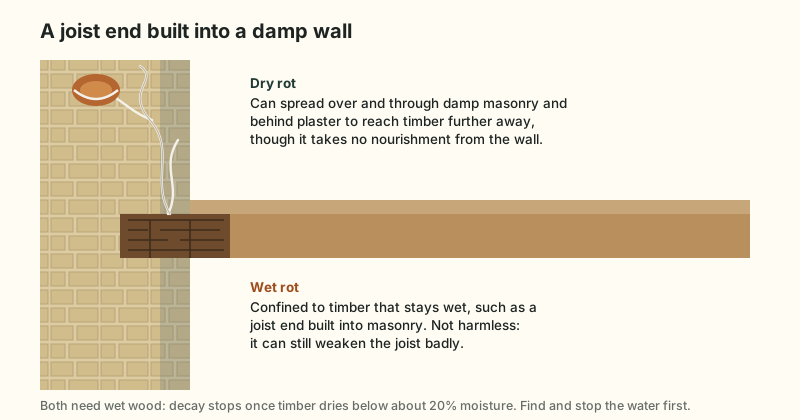
A wet bearing is also the deathwatch beetle's ideal home, as Ridout notes. Cement repairs can make it worse: SPAB says hard cement renders hinder evaporation, and that cement mortar in timber-frame cracks "will retain moisture and encourage decay". The same Council guidance warns that inappropriate alterations "could otherwise lead to a building up of damp, mould or dry rot".
The repair follows the water: dry the wall, repoint in lime where needed, cut decayed timber back to sound wood and splice or support the joist end.
Should the air bricks under a suspended timber floor ever be blocked?
No. Oxford City Council's heritage retrofit guidance says that for suspended timber floors, air bricks and ventilation should not be covered up. Historic England notes that timber suspended ground floors can stay damp and decay, and that external ground levels build up over the years, opening moisture routes that were not originally there.
A blocked air brick leaves the void under the floor still and humid, which suits rot. We check every air brick, look into the void and test joists and wall plates. On timber a damp meter gives reliable readings, according to RICS; on brick and stone it can give false highs.
How much does woodworm or rot treatment cost in the UK?
These are national yardsticks from other publishers, not our prices. Oxford Damp Specialists confirms a price when you book, once the extent is known.
| Work | National range | Source |
|---|---|---|
| Woodworm treatment, average | £500 to £1,000 | Checkatrade, prices June 2024 |
| Inspection for woodworm | £80 to £250 | Checkatrade, June 2024 |
| Loft treatment, 3-bed house | £400 to £900 | Checkatrade, June 2024 |
| Wet rot, minor | £500 to £1,000 | MyBuilder, undated |
| Wet rot, moderate | £1,000 to £2,500 | MyBuilder, undated |
| Dry rot, small and localised | £500 to £1,500 | MyBuilder, undated |
| Dry rot, whole property | £5,000 to £12,000+ | MyBuilder, undated |
| Joist replacement | £250 to £350 per joist | MyBuilder, undated |
The biggest variable is how much timber has to come out. The woodworm treatment cost guide explains when no treatment is needed at all.
Common questions
Old flight holes in my floorboards: is treatment needed?
Not if the infestation is no longer active. Treatment is only justified when fresh holes or bore dust show current activity, and much of the timber in Georgian and Victorian houses resists furniture beetle.
Can wet rot be left alone because it is not dry rot?
No. Wet rot weakens timber, which then has to be cut out and replaced. What sets dry rot apart is its ability to cross masonry and colonise more timber.
Are timber repairs in a listed Oxford house subject to consent?
Possibly. Oxford City Council says consent covers any work, internal or external, that affects a listed building's special character, including repairs that replace important fabric, so check before historic timber is cut out.
What time of year suits woodworm treatment?
Early spring to late summer, when adult beetles emerge, according to the PCA. Activity should be proved first, which can mean a check during that season.
Sources for this page
- Wood Destroying Insects in Buildings. Property Care Association, May 2016
- Insect Damage to Timber, Dr Brian Ridout. Building Conservation Directory, 2005
- Approved Document A, Structure (2004 edn incorporating 2004, 2010 and 2013 amendments), para 2B2 and Table 1. SpecifiedBy
- Treating woodworm. Property Care Association, © 2024
- Integrated Housing Stock Database. BRE for Oxford City Council, 23 Jan 2014
- Listed buildings in Oxford. Oxford City Council, page dated 12 Dec 2023
- Listed building consent. Oxford City Council, page dated 12 Dec 2023
- Wood rot. Property Care Association, © 2024
- Wet rot treatment. Property Care Association, © 2025
- Dry Rot and its Treatment in Historic Buildings, Janice Carey and Colin Grant, BRE. Building Conservation Directory, 1999
- Dealing with dry rot: insights from fungal biology, Sarah Watkinson Consulting. Property Care Association, undated
- Technical Advice Note 15 Heritage Retrofit Guidance, May 2024. Oxford City Council
- Technical Advice Note, Control of Dampness, Douglas Kent. SPAB, 2018; Edn 1 Rev 1, 2020
- Understanding Decay in an Older Home. Historic England, undated
- Damp and mould, consumer guide. RICS, 16 Jun 2025
- Woodworm treatment cost. Checkatrade, updated 9 Sep 2024; prices Jun 2024
- Dry rot treatment cost. MyBuilder, undated
Before you call
A few details let us narrow down the likely cause on the phone.
- Postcode and the rough age of the building
- Which rooms and walls, and how far up
- Whether wet weather or cold snaps change it
- Where any mould is growing
- Owner, tenant or buyer, and any deadline
Woodworm and rot treatment outside Oxford
Need woodworm treatment outside the city boundary? Each town page below looks at that town's houses, ground and rivers, and our damp proofing in Oxford page explains how we work.
Worth reading first
What does woodworm treatment cost?
Those tiny round holes in your floorboards may be decades old, so prove the beetles are alive before paying anyone to spray.
Dry rot or wet rot: how do you tell them apart?
Strands creeping over brickwork or a soft joist end: how to read the signs of rot, and why the water decides the repair.
Related work
The rest of the list
Damp surveys
Before you exchange, accept a retention or agree to injection work, find out where the water in that Oxford wall is really coming from.
Rising damp treatment
A tide-mark along the skirting is a clue, not a verdict: we prove rising damp, clear whatever bridges the course, and only then treat.
Penetrating damp repairs
The patch that darkens every wet October usually starts at a gutter, chimney or crumbling joint, so we follow the rain from outside in.
Condensation and mould
Black mould behind the wardrobe is a symptom: we trace the cold surface, the weak extract fan and the humidity feeding it.
Shall we call you instead?
Your name, number and the property postcode are all we need. A sentence about the room and the wall makes the first call quicker. Or ring 01865 537413.