Condensation and mould in Oxford
Condensation and mould diagnosis in Oxford for homeowners, landlords, tenants and shared houses. We measure humidity and cold surfaces, check every extract fan and find why water is settling on your walls, so the mould stops coming back instead of being wiped away each winter.
Tell us where the mould is
Postcode, phone number and a word about the problem. We call back, ask a few questions, and book a visit if it needs one.
- Humidity and surface temperatures logged
- Extract fans checked against Part F
- Plain findings for landlords, tenants
Is condensation the most common cause of mould in Oxford homes?
Yes. Condensation is the commonest kind of damp in English homes and rising damp is the least common. In the 2024-25 English Housing Survey, surveyors recorded severe condensation in 3% of homes, against 2% for penetrating damp and 1% for rising damp. Health guidance from OHID, MHCLG and UKHSA also ranks condensation as the commonest damp.
Renters are hit hardest: the same survey records serious condensation in 6% of private rented homes against 2% of owner occupied ones. In Oxford, 32.2% of households rent privately against 20.5% across England, per the City Council housing statistics.
This is not a verdict on how people live. That same guidance firmly rejects pinning damp and mould on the way a household lives. Oxford Damp Specialists treats condensation as a building problem, as part of damp proofing in Oxford: where is the cold surface, and where should the moist air have gone?
How do you tell condensation mould from rising or penetrating damp?
Condensation shows as mould and wet glass in cold, still places: top corners of outside walls, window reveals, behind furniture. Rising damp sits low on a wall; penetrating damp tracks back to a defect outside. The signs overlap, so we test rather than guess.
The Property Care Association code for investigating dampness warns that low-level condensation can be confused with rising damp, though its moisture is usually superficial and salts are absent. It adds that mould can grow below the humidity needed for droplets to form, citing 80% relative humidity at external walls. SPAB says tests through the wall thickness can rule out surface condensation, and warns that a single set of high meter readings can wrongly point to rising damp.
A damp survey for mould therefore covers humidity, surface temperatures and, where needed, readings logged over days; BRE calls such monitoring the most effective way of diagnosing damp. If the readings point elsewhere, the work moves to penetrating damp repair or rising damp treatment.
Why does mould keep growing in the same cold corner every winter?
Because that corner is colder than the rest of the room. Condensation forms where a surface falls below the dew point of the air, typically where air circulation is poor, as the PCA Code puts it. Usual suspects are the top of an outside wall where loft insulation stops short, window reveals and a solid wall behind a wardrobe: cold bridges that lose heat faster than the wall around them.
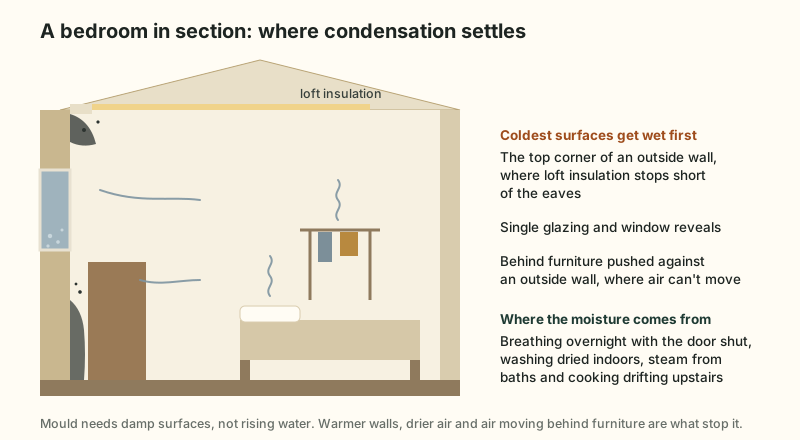
Oxford winters make it seasonal. Met Office 1991 to 2020 averages for Oxford give 8.6 air frost days in December, 8.4 in January and 7.5 in February, most of the year's 33.7, plus about 118 rain days a year. Our guide to condensation in the bedroom covers those months in detail.
Steady, moderate heat in every room beats heating some hard and leaving others off, says the NHBC homeowner leaflet, which also advises running the extractor for about 20 minutes after cooking or bathing and keeping trickle vents open. The government's HHSRS guide for landlords adds that "Inadequate heating will also contribute to damp and mould". Insulation needs care: Oxford's Heritage Retrofit Guidance says internal wall insulation on older walls must be vapour-permeable and go only on walls free of damp.
What extract fan rates does Approved Document F set for kitchens and bathrooms?
For intermittent fans, Approved Document F (2021 edition, for work from 15 June 2022) sets these minimum rates: kitchen, 60 litres per second (30 l/s where the extract is a cooker hood); utility room, 30 l/s; bathroom, 15 l/s; WC, 6 l/s, per BEAMA guidance on Part F. We check whether each fan is working and suited to the room.
dMEV (decentralised mechanical extract ventilation) uses several small extract units in different rooms, each running continuously and independently, as Homebuilding and Renovating explains. PIV (positive input ventilation) works the other way: a loft fan blows filtered air in through a ceiling diffuser, gently pressurising the house so stale air is displaced outwards. It needs loft space and draws cold loft air in winter, and since PIV supplies air rather than removing it, Part F extract in kitchens and bathrooms is still required.
Upgrades change the rules. Under the Part F simplified method, more than two minor energy measures, or one major measure such as full double glazing, means the home needs a Part F compliant ventilation system. The current moisture code of practice, BS 5250:2021, covers problems "other than just condensation", which is why we assess heating, ventilation and fabric together.
Is it enough to wash black mould off the wall?
No. Washing removes the growth, not the reason it grew. The government damp and mould guidance says mould can be cleaned off hard surfaces, with mould and mildew products preferred to bleach and larger areas left to qualified professionals, but warns that cleaning the surface alone will not keep damp and mould from returning.
The health stakes are real. Damp and mould primarily affect the airways and lungs, and the guidance links them to approximately 5,000 cases of asthma and 8,500 lower respiratory infections in 2019. Children, older adults, pregnant women and people with respiratory or immune conditions are at greater risk.
Oxford Damp Specialists makes the surface safe, then fixes the cause. As a national yardstick, Checkatrade (prices May 2024) puts mould removal at £200 to £400 per room; our price is confirmed when you book. The damp proofing cost guide explains what moves it.
Who must fix condensation and mould in a rented home in Oxford?
The landlord, where the cause is a repair, a design flaw or a hazard. Shelter England explains that condensation damp may be the landlord's responsibility if it causes a health and safety issue or comes from an unfixed repair or a design flaw such as inadequate ventilation.
Social tenants have Awaab's Law. Since 27 October 2025, social landlords must investigate significant damp and mould hazards within 10 working days and complete safety work within five working days once the investigation concludes; emergency hazards within 24 hours. Extending it to private renting is under consultation until 18 December 2026, with no start date set. Our guide to Awaab's Law sets out every timescale.
Oxford is one of the only councils in the country requiring a licence for all privately rented homes. The scheme's Year 3 report counts damp and mould in 424 properties and excess cold in 375 across inspections since September 2022. Tenants should tell the landlord in writing, keep evidence and allow 14 days, then report to the Council's Residential Regulation Team, which may inspect and serve an improvement notice.
How should condensation be handled in an Oxford shared house or student let?
By designing for the number of people living there. The Council estimates that 1 in 5 residents live in an HMO (a house in multiple occupation), one of the highest numbers in England and Wales. That is normal use, and the building has to handle the moisture it brings.
A shared-house bedroom is often also the study and drying room, which puts the weight on Part F extract in shared kitchens and bathrooms, heating that reaches every room, and no cold corners behind beds and desks. Oxford Damp Specialists checks all three, room by room. Shared houses also fall under a city-wide HMO licensing scheme that came into force on 25 June 2026.
Common questions
Why is there still mould when I keep the windows open?
Opening windows helps, but if a wall surface stays cold, or a kitchen or bathroom fan does not extract properly, mould can still grow. It can grow below the humidity needed for visible condensation.
Should I choose PIV or extract fans for condensation?
They do different jobs. PIV pushes filtered air in from the loft, while extract fans remove moist air where it is made, which is why Part F extract is still required in kitchens and bathrooms. PIV needs loft space, so a flat without one may suit dMEV instead.
My rented Oxford flat has mould: is the landlord responsible?
The landlord, where the cause is a repair, poor ventilation or a hazard. Tell the landlord in writing and allow 14 days; after that, Oxford City Council's Residential Regulation Team can inspect.
Will bleach stop black mould returning?
No. Government guidance prefers mould and mildew products to bleach, and warns that cleaning off visible mould does not stop it returning. The cold surface or missing ventilation has to be fixed as well.
Sources for this page
- EHS 2024 to 2025 housing quality, introduction and key findings. GOV.UK (MHCLG), 29 Jan 2026
- Understanding and addressing the health risks of damp and mould in the home. GOV.UK (OHID/DHSC, MHCLG, UKHSA), 7 Sep 2023, updated 1 Apr 2026
- English Housing Survey 2024 to 2025, Chapter 1: housing quality. GOV.UK (MHCLG), published 29 Jan 2026
- Housing statistics. Oxford City Council, undated (cites 2022 prices)
- Code of Practice for the Investigation and Control of Dampness in Buildings. Property Care Association, Mar 2017; hosted by Bath & NE Somerset Council
- What is rising damp? SPAB, undated
- How to treat damp in older houses, Douglas Kent of SPAB. Homebuilding & Renovating, 20 May 2020, updated 8 Apr 2024
- Diagnosing the causes of dampness in buildings. BRE Group, 29 Nov 2016
- Oxford location-specific long-term averages. Met Office, (1991–2020), checked 12 Nov 2026
- Technical Advice Note 15 Heritage Retrofit Guidance, May 2024. Oxford City Council
- Guidance on Part F of the Building Regulations for dwellings in England. BEAMA, 2022; ADF 2021 edn
- What is dMEV? Homebuilding & Renovating, 9 Jan 2024
- Positive Input Ventilation explained. Homebuilding & Renovating, 9 Sep 2021, updated 12 Jul 2024
- Condensation in your home. NHBC, 2024 leaflet
- Landlord and agent guide to the HHSRS. GOV.UK (MHCLG), 23 Jun 2026, updated 16 Sep 2026
- BS 5250:2021, management of moisture in buildings. BSI Knowledge, published 31 Oct 2021; catalogue page
- Mould removal cost guide. Checkatrade, header 14 Nov 2023; prices May 2024
- Damp and mould problems. Shelter England, updated 23 Jun 2026
- Awaab's Law: guidance for social landlords, timeframes for repairs. GOV.UK (MHCLG), 17 Oct 2025, updated 16 Jul 2026
- Extending Awaab's Law to private rented tenancies and to licences, consultation. GOV.UK (MHCLG), 9 Oct 2026; closes 18 Dec 2026
- Oxford's selective licensing scheme in third year of improving standards for private renters. Oxford City Council news, 25 Mar 2026
- Selective Licensing Scheme 2022 – Year 3 progress report. Oxford City Council, (Sep 2024–Aug 2025), page dated 7 Apr 2026
- Report damp and mould in a private rented or housing association home. Oxford City Council, page dated 16 Jul 2026
- HMO licensing background. Oxford City Council, page dated 8 Dec 2023
- Additional Licensing. Oxford City Council, (HMOs), updated 2026
Before you call
A few details let us narrow down the likely cause on the phone.
- Postcode and the rough age of the building
- Which rooms and walls, and how far up
- Whether wet weather or cold snaps change it
- Where any mould is growing
- Owner, tenant or buyer, and any deadline
Condensation and mould outside Oxford
Need condensation and mould outside the city boundary? Each town page below looks at that town's houses, ground and rivers, and our damp proofing in Oxford page explains how we work.
Worth reading first
Why is there condensation in my bedroom?
Wet glass at dawn and black spots behind the wardrobe: why bedrooms condense worst, and the heating and airflow changes that stop it.
Awaab's Law explained: deadlines for fixing damp and mould
Named after a two-year-old whose death was caused by mould exposure, Awaab's Law sets repair deadlines that private renters are still waiting for.
Related work
Damp surveys
Before you exchange, accept a retention or agree to injection work, find out where the water in that Oxford wall is really coming from.
Rising damp treatment
A tide-mark along the skirting is a clue, not a verdict: we prove rising damp, clear whatever bridges the course, and only then treat.
Penetrating damp repairs
The patch that darkens every wet October usually starts at a gutter, chimney or crumbling joint, so we follow the rain from outside in.
The rest of the list
Woodworm and rot treatment
Flight holes in an old joist can be long dead: we prove woodworm or rot is active and find the water before treating anything.
Basement and cellar tanking
Oxford sits on gravels where winter groundwater can lie under a metre down, so a dry cellar needs the right protection type.
Shall we call you instead?
Your name, number and the property postcode are all we need. A sentence about the room and the wall makes the first call quicker. Or ring 01865 537413.